
Introduction
As a public body, the Lancashire Combined County Authority (LCCA) recognises procurement as a core function that extends beyond legislative and procedural compliance and acts as a key lever in supporting the effective delivery of its strategic objectives, maximising effective service delivery, achieving value for money and driving continuous improvement and innovation. Procurement is the process of acquiring supplies, services and works, encompassing both third-party suppliers and in-house provision. The process spans the full procurement lifecycle (Figure 1), from identifying need and developing a business case, through to contract management, which includes effective contract exit management and the ensure any lessons learnt are considered in future requirements.
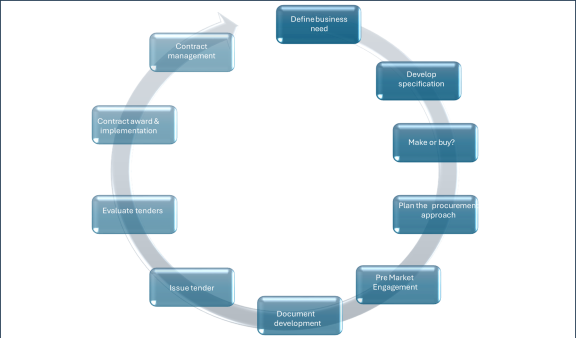
Figure 1 - Procurement lifecycle
A Lancashire-wide approach presents a significant opportunity for procurement to influence, innovate and make a meaningful contribution to the LCCA’s vision and overarching objectives. Given the scale of public expenditure involved, it is essential that procurement activity both maximises outcomes from spend and is underpinned by clear governance, consistent standards and effective oversight, supporting continuous improvement and the delivery of the best possible outcomes for Lancashire.
This Procurement strategic framework establishes the authority’s procurement policy position and strategic direction within a single, coherent document. It sets out the principles, rules and strategic approach that govern how the LCCA will procure goods, services and works, alongside the procedures and governance arrangements that support effective and well-managed procurement activity.
This document should be read in conjunction with the contract procedure rules which form part of the LCCA Constitution. Any procurement activity under this framework document will operate alongside the LCCA’s Social and economic value policy, in recognition of the strong relational links across the two areas, with social value being firmly embedded within the procurement process.
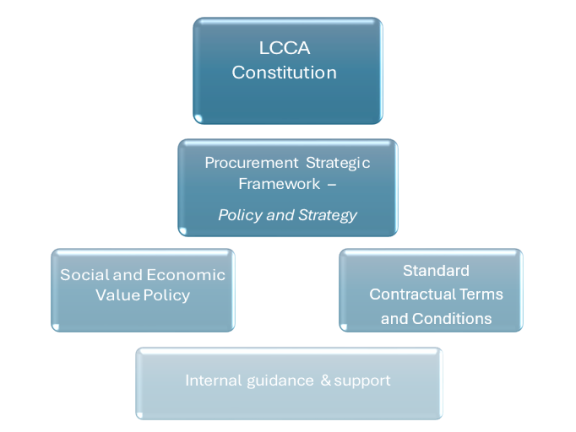
Figure 2 - Procurement framework
Scope
This Procurement strategic framework applies to all procurement activity undertaken on behalf of the LCCA, covering the acquisition of goods, services and works across the full procurement lifecycle. It applies to all officers and service areas involved in procurement activity and is intended to ensure a consistent, compliant and well-governed approach that supports the delivery of LCCA objectives and the effective use of public resources. In doing so, it supports transparent and well-governed decision-making and helps maintain the confidence of suppliers, partners and other stakeholders.
Procurement activity under this framework does not apply to employment contracts, land disposal or acquisition, or the instruction of legal counsel.
National and local context
All procurement carried out by the LCCA will be in line with relevant national legislation and policy drivers, including the Procurement Act 2023 (The Act), which came into effect in February 2025. The Act places transparency at the centre of public procurement and seeks to improve efficiency, fairness and openness in the way public bodies procure goods, works and services. Relevant legislation and key drivers include:
- Procurement Act, 2023
- Public Services (Social Value) Act, 2012
- National Procurement Policy Statement (NPPS), 2025
- LGA National Procurement Strategy for Local Government in England, 2022
The National Procurement Strategy for Local Government in England emphasises that procurement should be central to LCCA’s organisational thinking, providing opportunities to influence, innovate, and maximise positive outcomes from procurement spend, while contributing to the authority’s wider strategic objectives.
Understanding the local drivers and intended outcomes is key to ensuring the effectiveness of procurement in supporting the LCCA to deliver against its strategic themes and:
- drive economic growth, innovation and inward investment
- improve infrastructure and public transport
- enhance employment, skills, and digital connectivity
- support clean growth and sustainability
- deliver projects in a manner that ensures transparency and best value for public spending
At a local level the procurement approach and direction aligns with LCCA’s vision and objectives, supporting the delivery of strategic themes and remaining agile to respond to organisational priorities, including:
- Lancashire Growth Plan 2025 to 2035
- Get Lancashire Working
- Local Transport Plan
Purpose
As a newly formed authority, it is important for the LCCA to adopt a clear and unified approach to procurement to ensure that it fulfils its duty to deliver value for money. This Procurement strategic framework sets out how the procurement of goods, works and services will be carried out across the LCCA and aligned to the authority’s priorities and ambitions.
Together, the policy and strategic direction determine the focus of LCCA procurement activity, providing the overarching framework for all procurement across the authority. In doing so, it supports delivery of the LCCA’s objectives, link strategic themes to areas where procurement can contribute and make a positive difference, and ensure that the LCCA is prepared for challenges and opportunities arising from the internal and external landscape, including economic and legislative change and the need to remain responsive to future requirements.
The LCCA will procure goods, works and services that contribute to the delivery of high-quality, cost-effective provision, undertaken within a well-governed framework and in line with the LCCA Constitution. This document is not intended to operate as an operational guide, but to support consistent procurement activity that enables effective adherence to the Constitution and strategic direction, whilst ensuring that best-practice standards are upheld.
To effectively support LCCA ambitions, this document identifies actions based around three core strategic procurement themes, as promoted by the Local Government Association’s National Procurement Strategy toolkit. These themes aim to ensure that LCCA procurement:
- acknowledges the need for effective leadership and transparent, well-governed processes which embrace best practices
- behaves commercially; LCCA will ensure that its interactions with markets are effective and considered, not losing sight of overarching aims
- maximises community benefit; the roles that procurement has to play in achieving community benefits and the contribution of social value will be high on the agenda
In applying these themes, procurement activity will look to:
- support local economies
- encourage innovation
- support the development of jobs and skills
- support growing industries such as low carbon technologies, cyber security, and energy
- improve local infrastructure and transport
- enhance employment skills
- support digital connectivity
- support clean growth and sustainability
- embed social value
All public procurement is governed by a regulatory regime of responsibilities that promote value for money, transparency, equal treatment and non-discrimination, and these overarching values will be consistently adopted throughout LCCA procurement activity.
Key principles
The key principles that govern all procurement activity undertaken by the LCCA are set out in Figure 3. These principles apply to the authority and to all individuals involved in the procurement process and are intended to guide both decision-making and behaviour throughout the full procurement lifecycle.
| Principle | Applicaiton to LCCA procurement |
|---|---|
| Value for money | Procurement shall achieve value for money in terms of quality, outcomes and whole-life costs, ensuring the effective and responsible use of public resources. |
| Compliance | Procurement activity shall be conducted in compliance with relevant legislative and regulatory requirements and managed in a well-governed manner, supported by clear accountability and effective oversight. |
| Accountability | Decision-making shall be transparent and appropriately documented to ensure procurement activity and the use of public resources are auditable and open to scrutiny. |
| Strategic alignment | Procurement shall support and contribute to the LCCA vision, priorities, aims and objectives, enabling procurement to play an active role in delivering strategic outcomes across Lancashire. |
| Risk management | Commercial, financial and operational risks shall be identified, assessed and managed proportionately throughout the full procurement lifecycle. |
| Social value | Social value shall be embedded within procurement activity to maximise social, economic and environmental benefit and supported by the LCCA Social and economic value policy framework. |
| Inclusivity | Procurement shall maximise engagement opportunities and remove barriers to participation, particularly for SMEs and VCSFEs. |
| Collaboration | An integrated and collaborative approach to procurement shall be adopted to maximise outcomes for the whole of Lancashire and support innovation where appropriate. |
| Flexibility | Procurement activity shall remain agile and responsive as the LCCA and its areas of responsibility continue to develop. |
| Continuous improvement | Procurement practice shall support learning, innovation and continuous improvement to enhance capability, effectiveness and outcomes over time. |
Procurement conduct
Procurement conduct reflects and gives effect to the key principles set out above, translating them into consistent standards of behaviour, governance and assurance for procurement activity across the LCCA.
In conducting procurement activity, services must be able to demonstrate the following:
- contract procedure rules have been followed
- support services have been engaged early in the process (where appropriate)
- LCCA contractual terms and conditions are the default unless agreed with Legal Services
- there is a business case for the requirement
- appropriate approvals and authorities are in place
- appropriate levels of competition are conducted
- transparency requirements are adhered to
- decision making is clear, well documented and stands up to scrutiny
- any conflicts of interest are declared
- consideration is given to local markets
- contract records are maintained
- effective and proportionate ongoing contract management takes place
Market approach
Competitive procurement processes
In order to promote appropriate levels of competition the thresholds set out below shall be adhered to:
| Procurement area | Threshold 1 Service must demonstrate value for money and seek a minimum of one written quote with a | Threshold 2 Service to seek a minimum of three quotes* | Threshold 3 Opportunity advertised openly through Find a Tender Service under a legislatively compliant process. Procurement team must be consulted in advance |
|---|---|---|---|
| Goods | Less than £30,000 | £30,000 to £207,720 | Greater than £207,720 |
| Services | Less than £30,000 | £30,000 to £207,720 | Greater than £207,720 |
| Works | Less than £30,000 | £30,000 to £207,720** | Greater than £207,720 |
| Notes | Purchase order linked to LCCA low value T&Cs Service to self-serve Where possible seek quotation from | Service to consult with procurement to determine the extent of procurement support required Where possible seek quotation from Lancashire based suppliers Consult with legal regarding contract form. Where possible utilise standard (below threshold) T&Cs signed by authorised signatory | Process conducted with procurement and legal support via e-tendering portal Consultation and formal approval required Formal contract signed by authorised signatory |
Note all values are inclusive of VAT
*Where best endeavours have been made to seek a minimum of three written quotations but it has not been possible to satisfy this requirement within a reasonable time then in consultation with procurement and legal colleagues it may be determined that the rules have been satisfied
**Where it is not feasible for the opportunity to be advertised openly due to the nature of the contract and associated sector then the rationale should be documented and it may be permissible to seek a minimum of three written quotations where the contract value is below the statutory threshold
Where other procurement regimes apply (i.e. Provider Selection Regime or Light Touch applies) the rules and thresholds around the relevant regime shall apply.
Early market engagement
Early engagement with the market is an important part of delivering effective and well-informed procurement, building confidence in the tendering process. Undertaking a level of engagement prior to conducting a quotation or tender can support a better understanding from the market to best secure successful delivery as well as helping the market prepare for an upcoming opportunity.
It is permissible (and is in fact encouraged as good practice) to engage with the market prior to a tender but this should be done in a manner that does not negatively impact any future tender, ensuring that no suppliers are either advantaged or disadvantaged from the engagement.
While early market engagement can inform the design of a procurement process, it does not constitute a competitive process in itself. Services should engage the Procurement Team to plan and manage market engagement appropriately, ensuring that it aligns with LCCA’s strategic objectives, supports value for money, and contributes to effective outcomes for the authority and its stakeholders.
Engaging local suppliers
Wherever it is compliant and appropriate to do so, consideration should always be given to ensuring that suppliers based in Lancashire, its surrounding areas, or more widely in the UK, have the opportunity to compete for below threshold quotations and tenders. Services are encouraged to ensure that, where quotations are sought, consideration is given to seeking quotations from local suppliers, In doing so, the Key Principles of this Strategic Framework should be borne in mind, particularly considerations of value for money and ensuring that sufficient competition can be evidenced.
Whenever possible, tender opportunities shall be designed to ensure that local and UK based suppliers are not excluded or disadvantaged. We will seek to support the involvement of smaller, local and UK based businesses by removing barriers to participation and creating accessible routes to supply LCCA to derive maximum local benefit.
Where possible LCCA procurement activity will explore best means of engaging local and UK based suppliers, including:
- where appropriate disaggregating larger contracts into smaller lots to make opportunities more manageable and accessible for SMEs
- ringfence specific opportunities where appropriate to increase the likelihood of participation from SMEs and VCSEs
- host “Meet the Buyer” events to improve visibility of upcoming opportunities and build relationships across the supply chain
- signpost local businesses to available business support to increase their resilience
- maintain early and ongoing supplier engagement, ensuring continuous dialogue, feedback, and early‑market involvement
- ensure local suppliers and SMEs have a clear understanding of the LCCA procurement pipeline to facilitate planning and provide confidence in the tendering process.
Further advice should be sought from the Procurement Team where procurements are to be reserved to local or UK based suppliers, to ensure compliance with relevant legislation.
Alternatives to competition
Where an appropriate contract exists, the requirement to conduct a procurement process may be negated. Appropriate checks should be made to ensure that use of an existing contract is compliant and represents best value.
Where a compliant framework is in place, including a framework established by another contracting authority, a requirement may be met through entering into a call off contract from that framework. Guidance must be sought from legal and procurement officers to ensure the suitability and compliance of the proposed approach.
Approvals and internal support
Prior to the commencement of any procurement activity formal documented approval must be obtained at an appropriate level (see figure 4).
Whilst LCCA procurement activity is decentralised and services, in line with figure 4, may conduct their own competitions, services must seek procurement service support in advance, where total contract value in excess of £30,000 is anticipated. This will allow the LCCA to ensure compliance with transparency requirements through the publication of contract notices.
Early notification of anticipated procurement activity to procurement and legal support services is best practice and should be the standard approach.
Social value
All above-threshold procurement activity conducted on behalf of the LCCA will be undertaken in line with its duty to consider Public Services (Social Value) Act, 2012. Procurement presents a strategic opportunity to generate positive social, economic and environmental impact beyond the core requirements of contracts, contributing to the authority’s overarching objectives and delivering meaningful benefit to Lancashire communities.
In competitive processes over the statutory procurement threshold a weighting of a 10% will be applied to delivering social value. Any commitments made will become contractual obligations and delivery of these obligations will be monitored through contract management practices.
For procurement activity below the statutory threshold, consideration should be given to the appropriate application of social value.
LCCA has adopted a Social and economic value policy as part of its overarching procurement framework. The Social and economic value policy should be referred to when planning commissions and preparing procurement activity.
Contract formalities
LCCA standard contractual terms and conditions should be used as standard practice. Any deviation from the standard, approved contractual terms and conditions will only be withthe express agreement of Legal Services. Contract terms and conditions shall align with the requirements as set out in figure 4.
Contract management
To ensure value for money continues to be delivered and providers deliver against contractual obligations following contract award, services will embed effective contract management approaches into their operational practices. The LCCA will ensure that every pound of public money it commits is spent in a manner that delivers contractual obligations in the pursuit of meeting LCCA aims and objectives. Services are responsible for ensuring robust contract management takes place.
Risk management
LCCA will adopt a proportionate approach to risk management of projects. Measures will be embedded into the procurement process to mitigate against a variety of risks including compliance, financial, supply chain, modern slavery and data protection. Robust procurement and due diligence processes will support risk management and controls.
Due diligence
LCCA will ensure that only suitable suppliers who can be held to the highest standards are contracted with. Prior to contracts being entered into, appropriate and proportionate company and financial due diligence shall be conducted.
Assurance and reporting
Procurement activity will be undertaken in line with the LCCA Constitution to ensure delivery within a well-governed, transparent framework. Decision making will be well documented and procurement activity will be conducted with consideration to the local and national contexts.
Transparency will be embedded throughout the procurement lifecycle, from pre-procurement planning and decision-making, through procurement, evaluation, contract award, and ongoing contract management to contract exit.
All procurement activity must be conducted in a transparent manner in order to:
- be compliant
- promote confidence among suppliers and the public that our processes are fair
- support effective scrutiny
- support increased levels of competition
- ensure, where possible, that SMEs and local or UK based suppliers are able to compete for contracts
- ensure effective contract administration and management
All procurement decisions and activities should be documented to create a full and transparent audit trail, including but not limited to:
- approvals
- business case
- procurement documents
- supplier proposals
- evaluation records
- purchase order
- contract
The Procurement Act places obligations on the LCCA as a contracting authority, to publish transparency notices of its tendering opportunities and contract awards. The procurement support service must be made aware of any contract with an anticipated value in excess of £30,000 in order to ensure that transparency notices are published where required on the government’s Find A Tender Service portal.
To support strategic oversight and governance, procurement risks should be identified at operational and project levels and recorded in a risk and opportunities register, which is reviewed regularly.
Action plan
To support ongoing improvement and to allow broader benchmarking, the Local Government Association has developed three core themes for procurement in a National Procurement Strategy Toolkit. These themes have been used to develop a strategic action plan for improvement, which can consistently be reviewed to determine progress and maturity in key areas.
A series of ‘enablers’ will facilitate delivery of each action and provide a focus for measuring success:
- Adding value: Maximising outcomes beyond cost savings
- Developing talent: Investing in procurement capability and training
- Exploiting digital technology: Using e-procurement and data analytics
- Enabling innovation: Encouraging supplier creativity and new delivery models
- Embedding change: Continuous improvement and maturity assessment
| Theme | Action | Enablers | Outcome | Timeline |
|---|---|---|---|---|
| Leadership | Signed off Procurement Strategy and supporting procurement documentation to facilitate effective, well governed commissioning | Adding value Embedding change Developing talent | Clear direction LCCA focus Alignment of core principles Clear procurement processes documented Process for regular communication between procurement leads at constituent authorities | February 2026 with review by April 2027 |
| Leadership | Transparent, consolidated approach through agreed annual pipeline of major procurement activity | Adding value Embedding change Enabling innovation Exploiting digital technology | Published pipeline Transparency for suppliers Supporting economic growth | April 2026 |
| Leadership | Systems in place to support effective processes and use of information enabling well informed decision making leading to best value outcomes | Adding value Exploiting digital technology Embedding change | Transparent oversight of procurement activity and delivery Contract Register in place Oversight of spend data Develop a suite of KPIs that facilitate a mechanism for monitoring key areas Compliance with Local Government Transparency Code | April 2026 |
| Leadership | Ensure effective collaboration with stakeholders to ensure that a cross functional approach to procurement and commissioning is embedded across the organisation. | Adding value Embedding change | Clear processes documented Transparency for internal stakeholder groups | Ongoing |
| Behaving commercially | Maximise the use of market engagement. Build early market engagement into procurement process to support suppliers with planning | Adding value Embedding change Enabling innovation | Alignment of principles Transparency for suppliers Promote opportunities to SMEs and local suppliers where possible | March 2026 |
| Behaving commercially | Utilise competitive processes effectively to drive best value outcomes | Adding value Embedding change Enabling innovation | Compliant processes Transparency | Ongoing |
| Behaving commercially | Develop and improve skills and capacity to ensure effective use of resources and effective ways of working | Adding value Developing talent Exploiting digital technology Enabling innovation Embedding change | Effective and consistent guidance and templates Shared best practices Implement e-tendering and purchase to pay technologies Develop data analysis to understand spend and support informed decision making | Ongoing |
| Behaving commercially | Develop and improve skills and capacity to ensure effective ongoing management of contracts in order to ensure maximisation of positive outcomes | Adding value Developing talent Exploiting digital technology Enabling innovation Embedding change | Adopt contract management framework Identify and disseminate contract Management skills building | April 2027 |
| Achieving community benefit | Ensure that Social Value considerations form a key requirement of procurement evaluations | Adding value Embedding change Enabling innovation | Minimum weighting for social value in procurement of above threshold contracts | February 2026 |
| Achieving community benefit | Social value considerations in procurement to include priority areas of focus | Adding value Embedding change Enabling innovation | Maximise local spend and develop local economy Support climate initiatives Drive carbon reduction | March 2026 |
Review
Whilst the LCCA is in relative infancy, there are well established areas of good procurement practice which are shared through existing networks and collaborations. Strategic organisational themes may develop and evolve at a rapid pace and in order to reflect this, and remain agile, actions identified in this document will be reviewed by April 2027, to ensure that the policy and strategy remain fit for purpose, responsive to evolving organisational priorities, and aligned with changing statutory or operational requirements.