
A thriving Lancashire: A national growth priority
Lancashire is a powerhouse of potential, home to 1.57 million peoplei, over 55,000 businesses, and contributing £40 billion in GVAii. As one of the largest economies in the north, Lancashire is poised to take a leading role in driving national economic growth. With more than 728,000 jobsiii, its economy is underpinned by world-class capabilities in advanced engineering, manufacturing, nuclear energy, cybersecurity, artificial intelligence, and clean growth.
This Growth Plan is the result of extensive collaboration with a wide range of stakeholders. It was launched at the 2025 Convention of the North in Preston, following a comprehensive consultation process involving sector groups, business organisations, individual enterprises, local authorities, universities, colleges, and Members of Parliament. This inclusive approach has shaped a bold and shared vision for Lancashire’s future - one that is ambitious, equitable, and nationally significant.
The newly formed Lancashire Combined County Authority (LCCA) is dedicated to delivering transformative change. The LCCA will:
- champion Lancashire’s interests nationally and internationally
- deliver regional priorities through targeted investment in innovation, infrastructure, and workforce development
- strengthen inward investment strategies, making Lancashire a prime destination for global capital, venture funding, and industrial R&D
- ensure that economic growth benefits the communities that need it most
Vision and framework for growth
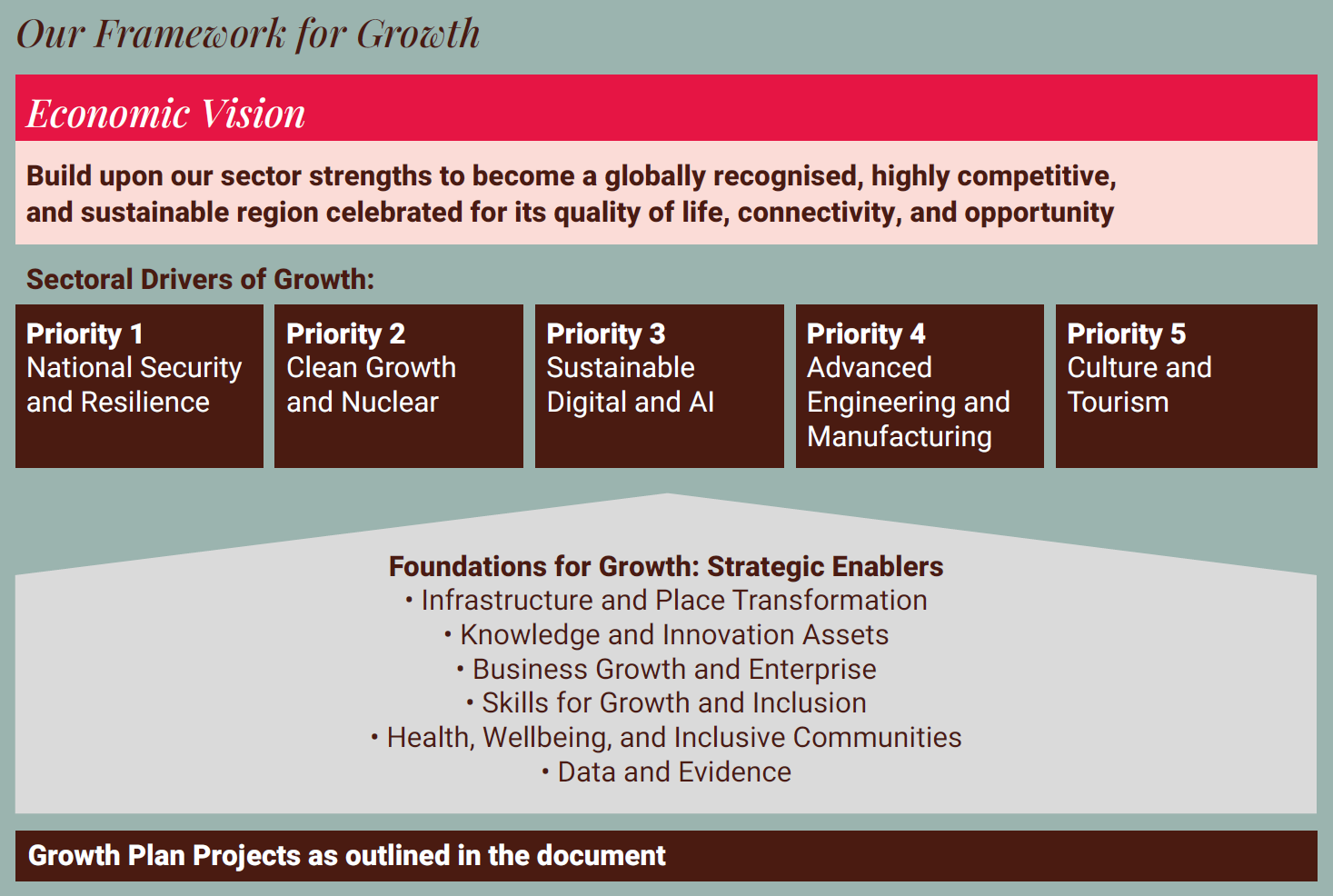
Lancashire’s vision is to build upon the sector strengths outlined in this Plan to become a globally recognised, highly competitive, and sustainable region celebrated for its quality of life, connectivity, and opportunity.
The Growth Plan outlines a clear strategy to achieve this by focusing on high-growth sectors that drive innovation and productivity, while also investing in the foundational pillars of success: transport, skills, housing, health, and innovation.
It also acknowledges the importance of foundational sectors such as public services, civil society, and health and social care. The plan promotes inclusive employment, cultural development, and community wellbeing as essential components of economic growth. Initiatives like the evolving Get Lancashire Working programme aim to increase employment and ensure residents benefit directly from the region’s prosperity.
Sectoral drivers for growth
Lancashire’s economic future is anchored in a set of priority sectors with strong potential for international expansion. While not exhaustive of the region’s diverse business base, these sectors are deeply embedded in Lancashire’s economic identity and are central to driving productivity, innovation, and job creation. They also play a pivotal role in the broader north west and northern economic corridors.
A key strength lies in Lancashire’s industrial clusters, concentrations of expertise and innovation that foster collaboration, accelerate growth, and enhance the region’s appeal to investors.
A strategic role in national security and resilience
Lancashire is home to the world’s fourth-largest aerospace cluster and plays a vital role in the UK’s defence and security ecosystem. The county’s capabilities in military aircraft production, nuclear fuel manufacturing, and emerging cyber technologies are major economic assets, closely aligned with the UK’s Industrial Strategy.
By leveraging the shared technological foundations across these sectors, Lancashire is well-positioned to develop new industrial clusters where businesses, academia, and communities collaborate. This integrated model will drive innovation, strengthen national security, and generate new economic opportunities. Additionally, Lancashire’s strong and sustainable rural economy plays a key role in UK food security, supporting a diverse supply chain from primary production to food manufacturing and retail.
Clean growth and a nuclear renaissance
Lancashire is a national leader in nuclear energy, with expertise spanning the full lifecycle, from enrichment and fuel production to power generation. Combined with a skilled workforce and strategically located sites, the county is primed to lead the development of next-generation nuclear fuels and energy systems. The region is also advancing in energy storage and efficiency technologies, supporting both offshore and onshore renewables.
These capabilities not only bolster energy security but also provide affordable, sustainable power to other key sectors. With one of the UK’s highest projected concentrations of green jobs between 2030 and 2050, Lancashire is poised to become a clean growth powerhouse.
Sustainable digital and artificial intelligence
Digitalisation and AI are transforming every sector of the economy. While these technologies offer significant productivity gains, they also bring challenges such as high energy and water usage, workforce disruption, and cybersecurity threats.
Lancashire is uniquely positioned to lead in sustainable digital growth. The north west hosts the UK’s second-largest cyber cluster, with over 300 companies and around 12,000 professionalsiv. Lancashire benefits from transatlantic digital connectivity, access to renewable energy, and a central role in the emerging North West Cyber Corridor. This positions the county to harness AI-driven innovation, create high-value digital jobs, and address the environmental and social impacts of digital transformation.
Advanced engineering and manufacturing excellence
With a proud industrial heritage, Lancashire remains a national leader in advanced engineering and manufacturing. The sector contributes around £6.4 billion to the local economy (18% of total GVA) and includes key industries such as aerospace, energy, chemicals, and commercial vehiclesv.
The Growth Plan supports these sectors through a resilient supply chain of mid-sized firms known for their innovation and adaptability. These businesses are well-placed to develop the next generation of low-carbon, high-value products, reinforcing Lancashire’s role in the UK’s industrial future.
Culture and Tourism as Economic Catalysts
Culture and tourism are integral to Lancashire’s identity and economic growth. These sectors attract talent, build community pride, and enhance quality of life. Blackpool, the UK’s most visited seaside resort, draws around 20 million visitors annually and supports a £1.5 billion visitor economy.
Lancashire’s tourism ‘offer’ spans vibrant towns, historic sites, and natural beauty. Since the launch of the Re(made) Cultural Strategy in 2020, the region has seen significant growth in cultural activity and infrastructure. The Growth Plan will build on this momentum, working with national partners such as the Department for Culture, Media and Sport to unlock the full potential of Lancashire’s cultural and tourism assets.
Foundations for growth: strategic enablers
The Growth Plan identifies six strategic enablers that underpin Lancashire’s ambition for a resilient, inclusive, and innovation-led economy.
Infrastructure and place transformation
We will deliver a Lancashire Spatial Development Strategy that integrates transport, energy, housing, strategic employment sites, and the natural environment.
Knowledge and innovation assets
We will unlock the full economic potential of Lancashire’s research institutions, innovation hubs, and globally competitive business clusters.
Business growth and enterprise
We will modernise the region’s business support ecosystem by reviewing the position of the growth hub in respect of the national approach to business support.
Skills for growth and inclusion
We will focus skills provision to meet business needs, inspire our future workforce, and drive inclusive growth.
Health, wellbeing, and inclusive communities
We will invest in health innovation, support pathways back into employment, and empower civil society and the VCFSE (Voluntary, Community, Faith and Social Enterprise) sector.
Data and evidence
We will build a robust data and intelligence infrastructure to guide decision-making, track progress, and support evidence-based policy development.
The case for growth: a clear evidence base to underpin the Growth Plan
Lancashire’s Growth Plan is underpinned by a comprehensive evidence base, including key strategic documents such as the Lancashire Independent Economic Review (2022) and the Lancashire 2050 Strategic Plan (2023). Despite challenges such as an ageing population and economic inactivity, Lancashire’s job density is sufficient to support its workforce.
The region’s economic output is concentrated along key transport corridors, with significant opportunities in advanced engineering, high-productivity clusters, and innovation assets. Addressing connectivity gaps and investment constraints will be crucial to sustaining growth and enhancing productivity, positioning Lancashire to be able to fully contribute to the UK’s economic ambitions.
Spatial priorities: Key clusters and corridors to enhance economic connectivity and collaboration
Lancashire’s Growth Plan focuses on enhancing economic connectivity through key clusters and corridors. Central to this strategy is the Central Belt along the M55–M65 corridor, encompassing major employment zones and innovation assets in Blackpool, Preston, Blackburn, and Burnley. The emerging North–South Cyber Corridor further strengthens this area, linking Lancaster, Samlesbury, and Manchester.
The plan aims to develop these corridors into cohesive economic zones, leveraging strengths and strategic transport routes. Addressing connectivity gaps and fostering collaboration with neighbouring regions is also crucial to unlocking Lancashire’s full growth potential.
Partnering with government: Unlocking Lancashire’s growth potential
The LCCA aims to unite local and national partners to champion the region’s unique assets and unlock their full potential.
Local commitment
- Focus on delivering transformational growth through targeted investment in economic development, transport, and skills
- Mobilise business leaders and local communities to promote Lancashire’s strengths and attract investment
- Invest in a data observatory to support evidence-led decision-making and align innovation capacity with industry needs
Securing government partnerships
Lancashire seeks targeted policy and investment support to deliver the 12 transformational projects, which will accelerate growth and deliver nationally significant outcomes in the following areas and support.
National recognition of strategic industrial strengths
- Support for key initiatives like the Global Combat Air Programme, Zero Emission HGV Supply Chain, AUKUS Submarine Programme, Rolls-Royce SMR Programme, and digital transformation across various sectors
Strengthening the advanced engineering and manufacturing supply chain
- Investment in a supply chain hub and STEAM centre of excellence
- Support for SMEs to adopt digital technologies, diversify into new markets, and form international partnerships
- Collaboration between academic institutions and industry to commercialise technologies
Digital and cyber innovation
- Investment to support the National Cyber Force HQ and associated programmes
- Advancing place-based initiatives like the Blackburn Cyber and Skills Campus and expanding the Multiversity skills campus in Blackpool
Energy affordability and clean growth
- Investment in clean energy infrastructure to reduce business costs and support the transition to a low-carbon and capture economic benefits from home grown clean tech innovation
Industries of the future
- Support for developing sovereign uranium enrichment capacity, transitioning to new nuclear at Heysham, advancing autonomous flight technologies, and more
Skills and workforce development
- Continued support for the Lancashire Careers Hub and prioritisation of devolved funds for skills development
- Strategic collaboration to ensure the workforce is equipped for future opportunities
Transport infrastructure
- Upgrades to key road networks, development of a business case for a fourth River Ribble crossing, strategic rail improvements, and expansion of the Superbus network
These initiatives aim to position Lancashire as a leader in innovation, industry, and sustainable growth.
Governance, monitoring, and evaluation
The Lancashire Growth Plan will be driven by the Lancashire Combined County Authority (LCCA) under new devolution arrangements, addressing underinvestment and promoting inclusive, sustainable growth. The LCCA will collaborate with businesses, local authorities, and public service providers to strengthen Lancashire’s voice and develop investment propositions.
Success will be monitored through a performance management framework with key performance indicators (KPIs) to track progress in economic growth, infrastructure, skills, quality of place, housing, and inclusive growth. Regular progress reports, stakeholder feedback, and adherence to budgets and timelines will ensure effective delivery.
Growth plan projects pipeline
The LCCA has worked with partners to develop a dynamic £20 billion plus pipeline of projects to implement the Growth Plan over the next decade. These initiatives include transformational (Appendix A) and wider Growth Plan projects (Appendix B – separate document), designed to deliver substantial economic, social, and environmental benefits. With the right support and investment, these projects will drive inclusive growth, foster innovation, and boost global competitiveness.
The LCCA has developed a robust approach to project development and prioritisation. This approach is closely aligned with the objectives of the Growth Plan and is grounded in credible economic analysis and HM Treasury Green Book principles. It will help provide a consistent framework in inform investment decisions across key themes such as transport and skills.
A call to action
Lancashire is not just ready for growth; it is actively driving it. We invite government, investors, and partners to join us in delivering a stronger, fairer, and more prosperous region. Together, we can unlock Lancashire’s full potential and power the next chapter of national economic success.