
Culture and tourism as economic catalysts
Lancashire’s geography, spanning coast, countryside, cities, and towns, offers a distinctive quality of place that sets it apart from more urbanised city regions such as Greater Manchester and Liverpool. This diversity underpins a compelling lifestyle and visitor proposition, blending natural beauty with cultural vibrancy and heritage. Culture and tourism are central to Lancashire’s identity and economic growth. They drive the creative industries, attract inward investment and talent, and support a thriving visitor economy that generates billions in revenue and thousands of jobs.
The latest figures from Visit Lancashire show that in 2023 Lancashire welcomed 67 million visitors, generating £5.4 billion in economic impact, a clear demonstration of the sector’s strength and importance to the county’s prosperity.
Over the next decade, planned investment in cultural, heritage, and visitor assets will enhance quality of life, boost wellbeing, and strengthen Lancashire’s appeal as a place to live, work, and visit. Two new strategies, a refreshed (Re)made Cultural Strategy and a new Tourism Strategy, will reinforce Lancashire’s position as a year-round, high-value cultural destination. Together, they will unlock strategic investment, harness digital and AI opportunities, and grow a tourism sector powered by a strong cultural offering.
Sectoral strengths and specialisms
Lancashire’s coast, countryside, cities, and towns will be promoted as a diverse, high-value destination. This will be built on cultural assets such as natural beauty, heritage, food, and the creativity of local enterprises. These strengths will be supported by improved connectivity, skills development, and stronger partnerships with national bodies including the Department for Culture, Media and Sport, Visit England, and Arts Council England.
The county’s approach reflects Visit Lancashire’s SMART tourism principles, which focus on sustainability, mutual benefit, accessibility, innovation, and the use of digital tools to guide development. The Lancashire coast, in particular, is fundamental to the economic revival of the tourism sector. Blackpool leads the UK in domestic family tourism, with 21 million visits in 2023 and a £1.5 billion visitor economyxix. Major projects such as the £300 million Blackpool Central development and the extension of the famous Illuminations are part of a wider £2 billion Growth and Prosperity programme.
Towns like Lytham St Annes, Fleetwood, and Morecambe each offer unique cultural and natural experiences, supported by bold regeneration strategies. Morecambe Bay’s creative resurgence includes the £100 million Eden Project Morecambe and the Morecambe Bay Triennial, a new coastal festival of community-led commissions. These initiatives blend accessibility, innovation, and cultural excellence, while the Morecambe Bay Curriculum is inspiring and engaging young people in sustainability and future opportunities.
Innovation and research
Lancashire’s Growth Plan is underpinned by a range of high-impact specialisms with strong cultural dimensions. These include tourism and hospitality, green skills and sustainability, cultural and heritage regeneration, and food-led and digital-first visitor experiences. These areas are increasingly supported by research and innovation in digital infrastructure, technologies, and creative entrepreneurship.
Lancashire’s investment in cyber, digital, and AI is also benefiting the creative industries. Inclusive skills pipelines, tech-enabled infrastructure, and cross-sector innovation are helping to build new creative clusters and digital production hubs. The Lancaster–Samlesbury–Manchester corridor, Blackburn Cyber Campus, and Silicon Sands in Blackpool are key locations supporting artistic innovation and talent retention.
Strategic opportunities and future growth
Lancashire’s growing reputation as a hub for nationally and internationally significant festivals will be a major driver of growth over the next decade. This momentum builds on the success of events such as Blackpool’s Lightpool Festival and the International Dance Festivals. Preston Guild 2032 is expected to generate over £20 million in direct investment, while Encounter Festival is enhancing local production capacity.
The Morecambe Bay Triennial, launching in 2027, will continue the coast’s creative revival through inclusive, high-quality commissions. Events like the National Festival of Making in Blackburn, the British Textile Biennial, and Burnley’s Year of Culture 2027 are helping to connect Lancashire’s industrial heritage with its creative future. These initiatives are also supported by the Light Up the North festival network, which fosters innovation and artistic development across towns including Blackpool, Lancaster, and Accrington.
Key locations and infrastructure
Culture is central to Lancashire’s growth and renewal, particularly across its main growth areas. The county is home to a wide range of cultural infrastructure, including Arts Council England National Portfolio Organisations, Creative People and Places projects, a Regional Music Hub, 64 libraries, and nationally significant museums. A growing network of creative hubs connects communities to opportunities in the creative industries.
Local councils, supported by government investment, are delivering cultural and heritage programmes that improve wellbeing and drive regeneration. One standout example is Super Slow Way’s Linear Park, a transformative green/blue corridor along the Leeds–Liverpool Canal. This project connects communities through creativity, wellbeing, and the repurposing of industrial heritage, stretching from Northlight in Brierfield to Imperial Mill in Blackburn.
Another major development is ANIMATE, a £45 million cinema and leisure complex in Preston’s Harris Quarter. This project is revitalising the city centre and supporting the council’s broader regeneration strategy. Strategic initiatives are also emerging across the county, including the Blackburn Screen Industries Strategy, a creative writing hub in Accrington, and the transformation of The Harris in Preston into a modern cultural anchor. Universities in Lancaster, Edge Hill, and the University of Lancashire are leading on cultural research, entrepreneurship, and digital skills development.
Tourism employment distribution
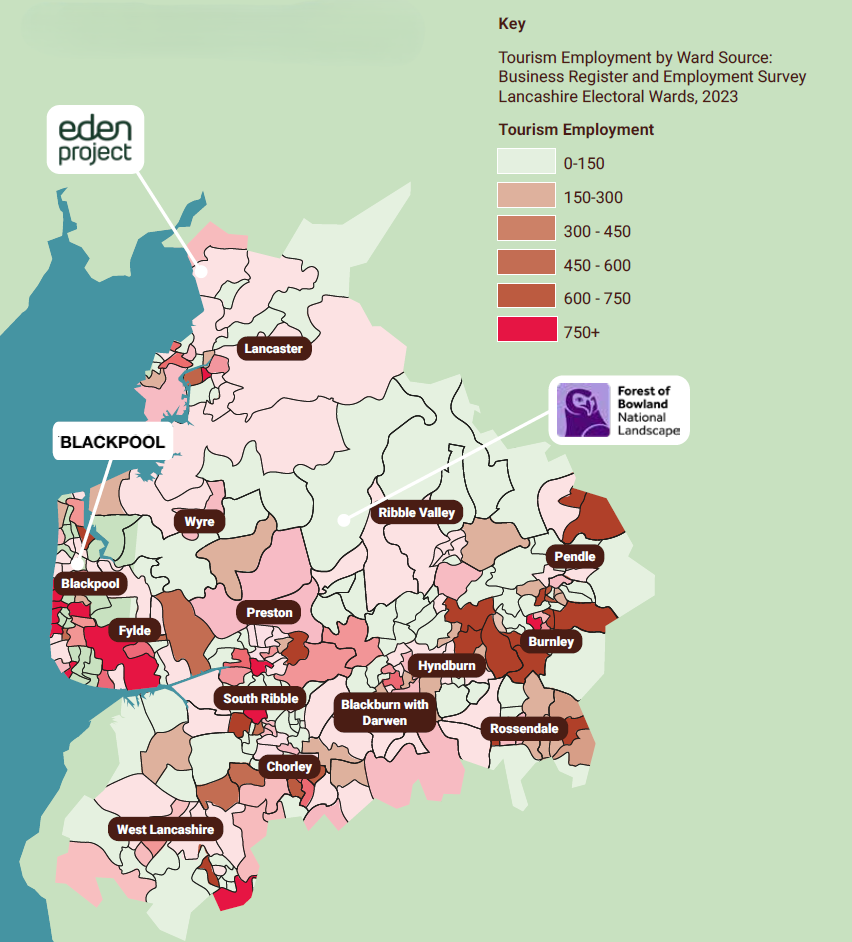
Case study: Blackpool - Driving sustainable tourism and cultural growth in Lancashire
Blackpool, with a nationally recognised brand and core audience of value-seeking domestic families, is well-placed for government investment in skills and people to drive inclusive, sustainable growth for Lancashire and serve as a flagship partner for government and a model for cultural regeneration. The town is focused on broadening its appeal to build upon its strong brand and diverse business base to broaden its appeal and enhance the visitor experience through investments in quality accommodation, cultural programming, and year-round free events.
Its assets, including historic landmarks and venues like the Winter Gardens, Grand Theatre and new Showtown museum, position the town as a cultural gateway to Lancashire for high-value cultural breaks. Innovation in digital marketing, virtual reality and sustainable infrastructure keeps Blackpool ahead of tourism trends.
Signature events like the Winter Gardens dance festival attract international visitors, extend stays, boost local spending and are a clear source of growth strengthening Blackpool’s position as a leader in cultural and coastal tourism. The dynamic visitor economy supports residents by providing employment opportunities, particularly for young people and underserved communities. As visitor numbers grow, so do job opportunities, enhancing local resilience and community pride.
Growth Plan projects supporting culture and tourism
Lancashire’s cultural and tourism strategies are underpinned by a growing portfolio of transformational projects designed to scale up the county’s cultural assets, attract new investment, and deliver inclusive growth. These initiatives aim to develop new creative clusters, expand digital infrastructure, and embed culture more deeply into Lancashire’s broader economic and social strategies.
A Lancashire Cultural Prospectus is being developed as part of Re(made) to align these efforts with the county’s wider growth ambitions. Blackpool, recognised as an Arts Council England Priority Place, is leading the way in domestic tourism and is developing a compelling coastal cultural offer, supported by the Eden Project Morecambe. Nearby destinations such as Lytham St Annes and Fleetwood offer coastal charm and heritage, while urban centres like Blackburn, Lancaster, and Preston provide strong civic leadership and cultural infrastructure.
Across this diverse landscape, culture is shaping strategic priorities - from economic growth to wellbeing and environmental sustainability. The programme of activity will contribute to a shared vision for Lancashire and provide a framework to assess the potential of new or emerging propositions that align with the county’s growth objectives.
Transformational projects
Blackpool Central Leisure Development
This project aims to transform a prime seafront site into a world-class, year-round visitor destination.
Morecambe Seafront and Eden Effect
The Eden Project Morecambe will reimagine the seafront as a 21st-century eco-tourism destination, driving regional regeneration, job creation, and visitor growth across north Lancashire.
Key actions to support culture and tourism
To fully realise the potential of culture as a driver of inclusive and sustainable growth, Lancashire is focusing on a series of strategic actions. These include exploring the development of an iconic cultural symbol project that can serve as a flagship for the region’s creative identity. The county is also prioritising the strategic development of Lancashire as a year-round, high-value tourist destination, built on its cultural assets and the ability to connect heritage with contemporary experiences.
Support for cultural infrastructure is central to this approach. This includes scaling up existing assets, attracting new investment, and ensuring that culture contributes to place shaping, health and wellbeing, and the delivery of the wider Growth Plan. Artists and creative enterprises will be supported through pathways into employment and the development of sustainable, resilient organisations that reflect the diversity of Lancashire’s communities.
Cross-sector innovation will be encouraged, particularly where culture intersects with health, gaming, immersive technologies, and other digital applications. These collaborations will help nurture a tech-enabled creative ecosystem that spans both public and private sectors.
The emerging Cultural Prospectus of key cultural and heritage assets will unlock their potential in delivering wider growth priorities, including placemaking, community development, skills, and job creation. This will be supported by Lancashire Re(made), a refreshed cultural and creative industries strategy focused on quality of life, health and wellbeing, tourism, inward investment, and careers in the creative economy.