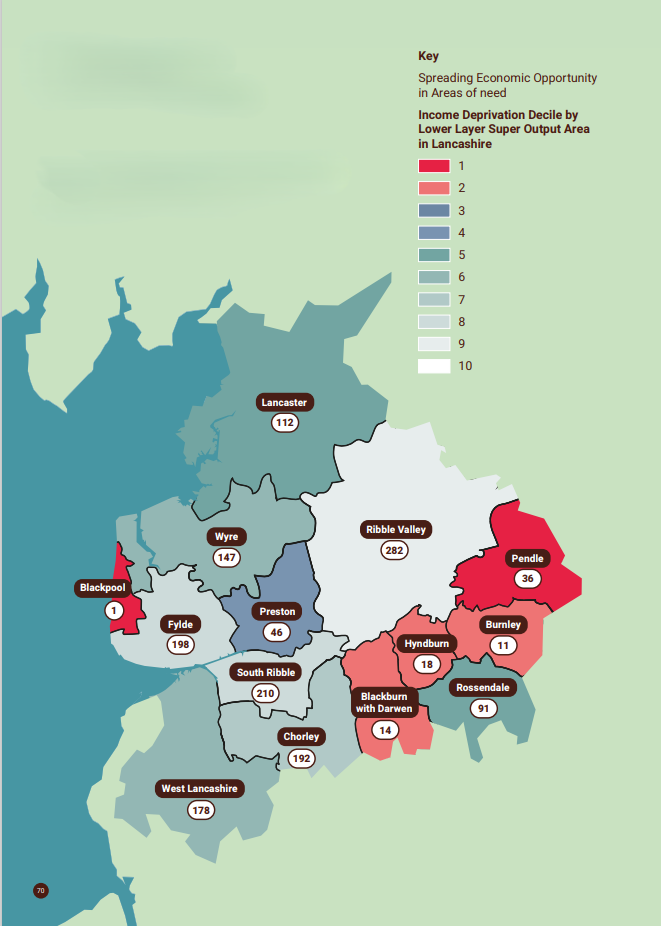
Key clusters and corridors to enhance economic connectivity and collaboration
Lancashire’s spatial focus is on unlocking the potential of its interconnected economic geography. At the heart of this emerging strategy is the Central Belt, which runs along the M55–M65 corridor and is anchored by Blackpool, Preston, Blackburn, and Burnley. This corridor contains the majority of Lancashire’s major employment zones, population centres, and innovation assets. It also serves as a vital west–east route for the movement of goods and people, with Preston acting as a key north–south transport hub.
The Central Belt is further strengthened by the emerging North–South Cyber Corridor, which links Lancaster, Samlesbury, and Manchester. This corridor supports high-growth, high-tech businesses, including university spin-outs and digital entrepreneurs in north Lancashire, helping to foster innovation across both corridors.
The Growth Plan aims to develop the Central Belt into a cohesive economic zone by leveraging existing strengths, future opportunities, workforce concentrations, and strategic transport routes. This will create a super corridor of innovation assets, further and higher education institutions, economic clusters, and development-ready sites for private investment.
Lancaster plays a complementary role in this geography. Positioned at the gateway to Cumbria, it is home to clusters in digital, renewable energy, health innovation, and university spin-outs. Its strategic location along the M6 and West Coast Mainline connects it to the Central Belt and supports wider initiatives such as the Blackpool Airport Enterprise Zone and the National Cyber Security programme contributing to the development of the emerging Lancaster- Samlesbury-Manchester cyber/digital corridor.
Lancashire’s economic geography is increasingly integrated with neighbouring regions including Cumbria, North and West Yorkshire, Greater Manchester, and Merseysidexl. Areas such as Lancaster, Rossendale, and West Lancashire have particularly strong external economic links. The Growth Plan recognises these relationships and seeks to build on them through collaborative projects and shared ambitions.
Lancashire’s economy is polycentric, with multiple interconnected towns and cities rather than a single dominant urban centre. This structure is illustrated in maps on pages 66-70, which show the proximity of clusters, transport routes, settlements, universities, major projects, and cross-boundary economic connections.
However, fragmented connectivity, particularly poor east–west public transport, limits the potential for agglomeration. This restricts collaboration, innovation, and labour market mobility across the Central Belt. Addressing these gaps is a key priority in the LCCA’s forthcoming Local Transport Plan.
The Central Belt includes several major economic clusters, such as the Enterprise Zones at Blackpool Airport, Hillhouse, and Warton (on the Fylde Coast), and Samlesbury (between Preston and Blackburn), along with Springfields site (west of Preston) and the Blackburn Growth Axis. Our Plan also includes substantial urban growth and regeneration opportunities in Blackpool (including Blackpool Central and projects in the Blackpool Town Prospectus), Preston (including Station Quarter), Blackburn (including Blackburn Cyber and Skills Campus), and Burnley (including the Town Centre Masterplan). Lancaster offers a
complementary proposition, including Heysham Gateway, Eden North, the city centre, and the Health Innovation Hub centred around Lancaster University. Our transport priorities will ensure effective connections to meet the needs of existing businesses and unlock the full growth potential of these areas.
Many of Lancashire’s economic opportunities are located within or near areas of high deprivation. The Growth Plan commits to smart, integrated investment strategies that promote inclusive and sustainable growth. This includes improving connectivity between communities and employment opportunities, addressing transport-related social exclusion, and creating new pathways to education, training, and high-quality work. Promoting walking and cycling for local journeys and improving access to public transport will also help improve health and economic participation.
Lancashire’s rural areas are also a major asset. They include National Landscapes, as part of a National Park, conservation sites, market towns, and diverse housing markets that help attract global talent and retain ambitious residents. However, limited public transport leads to car dependency, long journey times, and congestion. The Growth Plan will explore innovative transport solutions to improve rural connectivity and support modal shift into the Central Belt.
Finally, the Plan recognises historical and cultural barriers to agglomeration across Lancashire. Poor connectivity between towns, short travel horizons, and limited visibility of opportunities contribute to fragmentation. By promoting a stronger economic identity and fostering collaboration across “Team Lancashire” partners, the Growth Plan aims to overcome these barriers and deliver inclusive, sustainable growth.
Lancashire's emerging growth corridor map
This map shows the main economic corridors and assets including the anchor strategic employment sites and Higher Education Institutions.
Note: This is a live and dynamic list of economic growth sites informed by a Lancashire Strategic Sites Report (Stantec, 2025). The sites demonstrate Lancashire’s emerging economic corridors and will be developed further by the LCCA. The next steps for consideration by the LCCA include identifying where strategic housing sites and opportunities are emerging.
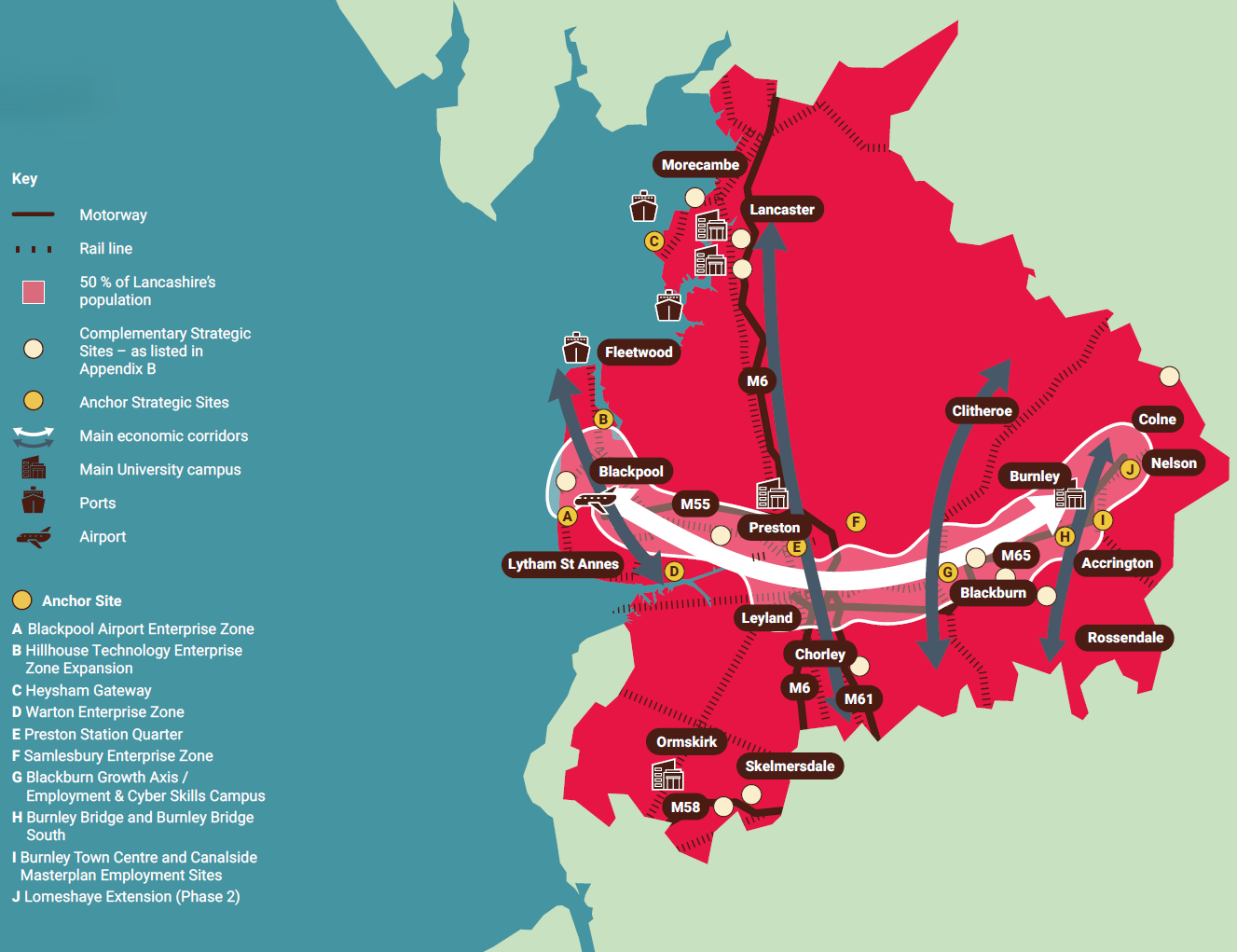
Lancashire'seconomic relationships with the wider north
Cumbria
Economic growth opportunities in tourism, nuclear and defence. Enhanced road and rail links facilitate movement, while further joint initiatives in advanced manufacturing and environmental sustainability will strengthen ties.
Greater Manchester and Cheshire and Warrington
Both areas benefit from strong transport connectivity and collaborative projects in advanced manufacturing and innovation, including cyber. Enhanced commuting patterns and joint initiatives will drive economic growth.
Liverpool City Region
Significant economic opportunities in logistics, manufacturing, and innovation. The Port of Liverpool plays a crucial role in facilitating trade, while collaborative projects in advanced manufacturing and technology (including in food and drink and life sciences) will boost growth.
Yorkshire
Shared economic growth opportunities through improved transport links, collaborative projects in manufacturing and innovation, and business interactions. Enhanced connectivity and joint initiatives will drive economic prosperity.
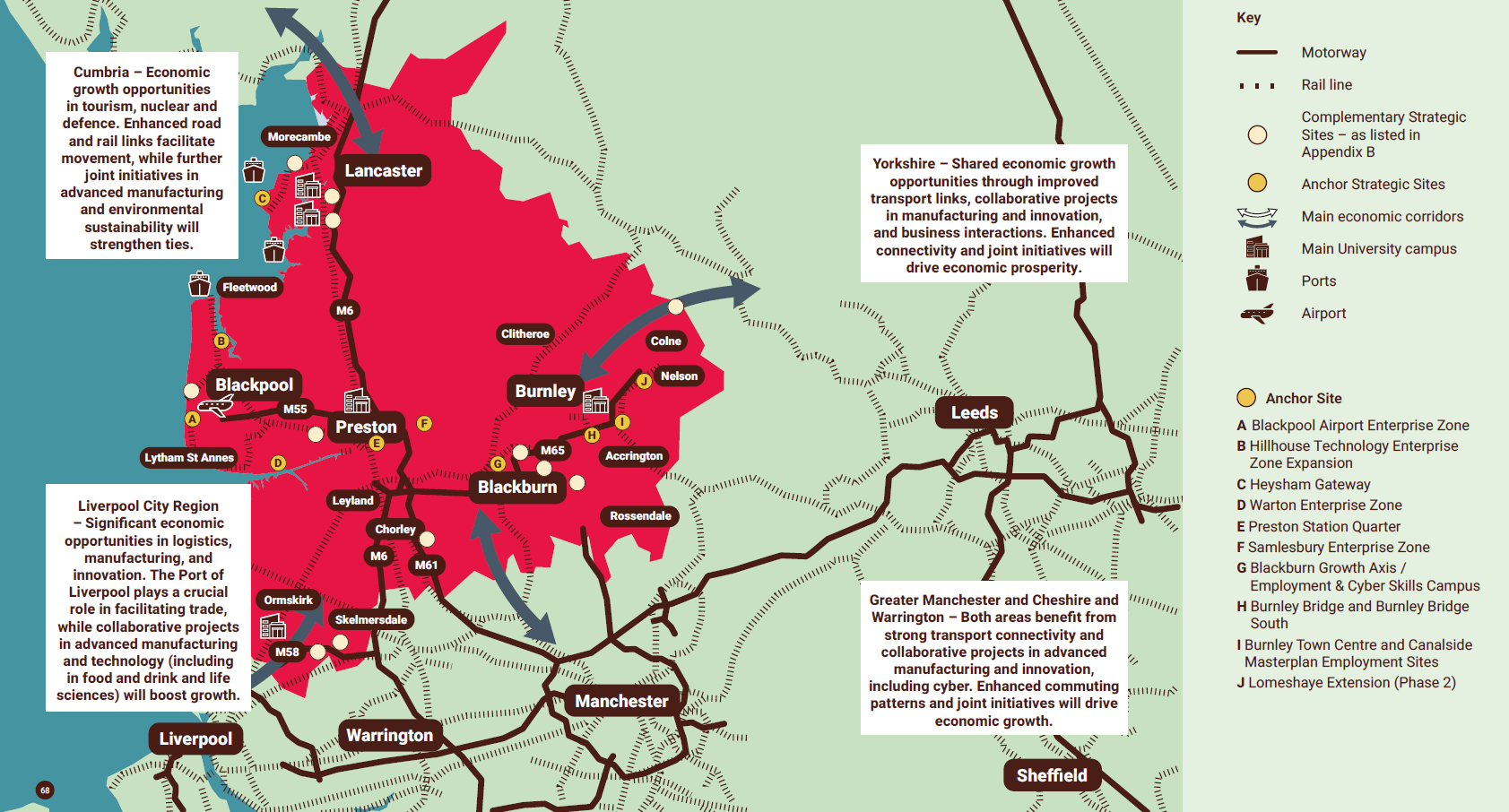
Map showing areas of economic need across Lancashire