
Creating the conditions for inclusive economic growth
Lancashire is defined by its vibrant towns and cities, strong local identities, rich heritage, diverse communities, and outstanding natural landscapes. Place-based growth strategies and masterplans are beginning to deliver regionally significant outcomes. However, further action is needed to close performance gaps with the rest of the UK and ensure that growth is inclusive and sustainable.
This section outlines the infrastructure, skills, and social foundations needed to support inclusive growth across Lancashire.
Infrastructure and place transformation
A future Lancashire spatial development strategy
To develop a strategic framework for development and land use to underpin and accelerate economic growth and quality of place.
Lancashire’s Spatial Development Strategy (SDS) will set out a long-term framework, with strategic policies to set out how land should be used and developed across Lancashire. Developed by the LCCA and aligned with the Local Transport Plan, the SDS will co-ordinate housing, infrastructure and economic growth enhancing quality of place across the county.
This approach is aligned with the English Devolution White Paper, which recognises Spatial Development Strategies as a key tool for devolved authorities to shape long-term, integrated, and locally led growth. The SDS is expected to be a statutory function of the LCCA, enabling Lancashire to plan strategically across local authority boundaries, coordinate investment, and deliver on national priorities such as net zero, housing, and economic resilience.
As a starting point the LCCA will work with local authorities and others on the development of evidence to inform the development of the emerging SDS.
Key infrastructure areas
Strategic, well-designed infrastructure is essential to creating competitive, connected, and sustainable places. Without it, business growth, housing delivery, and access to employment are constrained.
Transport and connectivity
Lancashire partners are working collaboratively to develop a single, ambitious Local Transport Plan, overseen by the LCCA. This Plan is informed by a comprehensive evidence base that identifies key transport challenges and opportunities for delivering a competitive, connected, and zero-carbon Lancashire over the next two decades.
Evidence highlights the impact of poor transport connectivity, which creates barriers for businesses and limits residents’ access to employment. Lancashire experiences high levels of transport-related social exclusion, contributing to poverty and poor health outcomes that prevent many economically inactive residents from entering the workforce.
East-west connectivity is a particular challenge, constraining labour market mobility, limiting innovation diffusion, and increasing business costs. Improving these connections, especially through enhanced rail, mass transit, and bus services, offers the potential to significantly boost productivity through better agglomeration.
Investment in pan-northern transport links will also support wider regional growth by improving connectivity to neighbouring regions, including Greater Manchester, Liverpool City Region, and North and West Yorkshire.
Place-based transport investment will enhance quality of place, attract inward investment, and unlock new housing and employment opportunities. Integrated with regeneration programmes, transport improvements will strengthen civic pride and local identity, while enabling sustainable development in towns and strategic growth locations.
By encouraging walking, cycling, and public transport use, Lancashire can improve public health, increase access to local jobs and services, and create the capacity for new homes and employment across the county.
The new Local Transport Plan will guide the development of a 20-year transport investment strategy. This will include a range of major projects, as outlined in Section 7, and will be rigorously tested to ensure alignment with Lancashire’s economic priorities, including productivity growth, regeneration, and inward investment.
Energy infrastructure
Lancashire is well-positioned to play a leading role in the UK’s transition to secure, clean energy. The county benefits from a strong combination of natural assets, a skilled workforce, and a growing base of energy-related businesses. The LCCA will take a proactive role in shaping the region’s energy future, working with key partners to align Regional Energy Strategic Plans (RESPs) with local priorities and opportunities.
This approach will ensure Lancashire receives the energy infrastructure required to power economic growth and support the deployment of more locally distributed energy systems. These systems will empower communities to generate and manage their own energy, contributing to energy resilience and sustainability. Lancashire is already home to several nationally significant energy supply and demand projects, further enhancing its strategic importance within the UK energy sector.
Housing
The LCCA is exploring opportunities to accelerate housing growth by learning from successful strategies in other combined authority areas. This will guide future engagement with government on planning, funding, and the devolution of powers to support delivery.
Working closely with local planning authorities and partners such as Homes England, the LCCA aims to develop integrated housing and economic strategies that support inclusive growth, workforce retention, and regeneration. High-quality, well-located housing is essential to improving wellbeing, reducing economic inactivity, and enabling long-term participation in the labour market.
Aligning housing delivery with Lancashire’s strengths in clean energy, defence, and cyber will help attract investment and talent. These sectors are already drawing significant interest and require a modern, diverse housing offer to support a skilled workforce.
Despite national challenges, several areas in Lancashire are demonstrating strong leadership through robust Local Plans and pro-growth strategies. With the right powers and infrastructure investment, the region can accelerate the delivery of high-quality homes in the right places to meet future demand and unlock economic potential.
Housing growth case study: The North East Blackburn Strategic Housing Site
The North East Blackburn Strategic Housing Site is the key housing growth opportunity within the Blackburn Growth Axis, and one of the largest single housing development sites in Lancashire. The site is located on the edge of Blackburn, close to established housing and employment growth areas such as the M65 Corridor, Samlesbury Enterprise Zone, the home of the National Cyber Force, and Blackburn Town Centre.
The 100-hectare site is expected to deliver up to 1,500 high quality homes, new open spaces, and a new community hub. It’s also ideally located as an urban extension to take advantage of, and boost, local centres and bus and rail services. The aim is to facilitate a sustainable development with strong environmental credentials. The site is allocated for housing development within the 2024 Local Plan for Blackburn with Darwen, and an ambitious masterplan will be published in early 2026. To accelerate the delivery of this regional housing growth opportunity, a £30M infrastructure package will be required to deliver all homes within the next 5 to 10 years.
Key employment sites and regeneration priorities
Lancashire’s town and city centres play a vital economic role as employment hubs, centres of commerce, and focal points for community life. These urban areas are not only engines of economic activity but also key to delivering inclusive growth through regeneration and placemaking. Revitalising town centres
is essential to addressing long-standing inequalities, attracting investment, and creating vibrant, resilient communities.
These centres are complemented by a network of strategic employment sites that support growth across a range of sectors. Recent analysis by Stantec consultants identified 30 of the most strategically significant sites in Lancashire. These are categorised into 11 anchor sites and 19 complementary sites, forming part of a series of growth corridors that span the county. These corridors are designed to unlock development potential, improve connectivity, and align infrastructure investment with economic opportunity.
While Lancashire currently has a good supply of strategic employment land through to 2035 (subject to build-out rates), this Growth Plan recognises the need to plan now for the post-2035 period. This includes identifying new strategic sites and considering extensions to the existing portfolio, informed by up-to-date Local Plans developed by local authorities.
Through the LCCA, we will continue to strengthen sub-regional analysis and strategic planning. This includes enhanced cross-boundary collaboration and a more integrated approach to understanding how employment sites relate to wider transport, housing, and infrastructure priorities.
Lancashire will also continue to develop a pan-Lancashire place marketing strategy. This will highlight land and premises availability, connectivity to Greater Manchester and Liverpool City Region, and the role of the LCCA in supporting inward investment. A forward-looking approach will be taken to identify sites capable of capturing growth in expanding and emerging sectors, working proactively with neighbouring areas and national partners.
The Growth Plan acknowledges the limited supply of large strategic sites across the North of England. Many existing businesses in Lancashire, particularly those with long-standing roots in the county, will need to modernise or relocate to remain competitive and sustainable. There is also a growing trend among global firms, particularly from the United States, for larger sites, often on a scale that the UK currently struggles to match.
To address this, Lancashire will seek to develop larger, more suitable sites that can accommodate a diverse range of occupiers, including domestic businesses, high-growth firms, and large-scale international investors. This will ensure Lancashire remains competitive in attracting and retaining investment, while supporting the evolution of its economic base.
Natural environment
Lancashire’s natural environment underpins the health, prosperity, and resilience of its communities. The county’s landscapes have historically supported the growth of manufacturing, tourism, and agriculture, while also offering a high quality of life. Future growth depends on the conservation and enhancement of these natural resources, which are essential to the functioning of businesses, supply chains, and communities.
Clean air, land, and water are critical for public health, economic security, and environmental sustainability. A rich natural environment also helps mitigate risks from natural hazards such as flooding, extreme heat, landslips, and wildfires. Future development projects will need to consider these factors from the outset to ensure long-term viability. The Local Nature Recovery Strategy has been designed to support both economic growth and nature recovery, ensuring that development and environmental stewardship go hand in hand.
Knowledge and innovation assets
Higher and Further Education assets
Lancashire benefits from a strong and collaborative higher and further education ecosystem, anchored by four universities and a network of further education colleges. These institutions are central to the county’s innovation, skills development, and economic growth ambitions.
The Lancashire Civic University Network and The Lancashire Colleges Principals’ Group foster collaboration between institutions and have contributed to the development of the Growth Plan. Together, these institutions support over 65,000 students across Lancashire and Cumbria, employ more than 10,000 staff, and generate a combined turnover of £891.2 million (2022/23)xli. They act as anchor institutions, contributing to local economies, communities, and public services.
University profiles
The University of Lancashire (formerly University of Central Lancashire)
The University of Lancashire is an international, multi-campus university tracing its roots back to 1828. It is one of Lancashire’s largest regional anchor institutions with teaching campuses in Preston and Burnley, and training campuses in Blackburn, Fylde, and across the county. The University collaborates on research with major international organisations, including the United Nations, the World Health Organisation, the European Space Agency, and NASA. It has established active partnerships with NHS trusts, police constabularies, and local, regional, and global businesses, working with more than 7,000 enterprises across various priority sectors.
Lancaster University
Lancaster University is consistently ranked in the top 15 of UK Higher Education Institutions and top 150 globally. Its reputation as a research-intensive institution is balanced by high educational standards and its respected position as an innovative and effective catalyst for change. Lancaster focuses on key societal challenges and specialises in multi and inter-disciplinary innovative engagement. Lancaster places equal emphasis on research, education, and engagement, and acts as local anchor institution, active facilitator, and enabler for securing opportunities that benefit communities locally, regionally, nationally, and internationally. The University contributes nearly £2 billion to the economy and produces a range of social goods from skills and spin-outs to community projects and policy support.
Edge Hill University
Edge Hill University is a campus-focused institution prioritising the delivery of skills, talent, and innovation for the four regions it serves. Acting as a hub between Lancashire, Greater Manchester, Liverpool City Region, and Cheshire, the University excels in teaching, innovation, business support, and world-leading research. Graduating over 3,500 students each year, the University has invested over £53 million in a long- term campus development programme, including a new Life Sciences building to house new degree programmes and research teams in engineering, mathematics, physics, chemistry, economics, politics, and graphic design to meet regional skills shortages. The University generates a total GVA uplift of £175.9 million across the UK economy, with £121.3 million directly benefiting the local economy of West Lancashire, and supports 2,695 jobs across the UK.
The University of Cumbria
The University of Cumbria has four locations across Cumbria, as well as its largest campus in Lancaster, Lancashire. Building upon 150 years of higher education, the University serves around 14,500 students and employs 1,200 staff. The Lancaster campus offers programmes in Business, Health, Education, and Teacher Training, all of which contribute real-world benefits to the region. Key partners include BAE Systems, Sellafield, Morecambe Bay Health Trust, Enterprising Cumbria and Rolls Royce. The University is an important higher education asset in Lancashire and continues to enhance its collaborative efforts through the Civic University Group.
Further Education Colleges
Lancashire offers an exceptional landscape for further and higher education, as well as technical and vocational training. The county is home to nine General Further Education Colleges and two Sixth Form Colleges.
Several institutions are recognised as national centres of excellence in key sectors such as maritime and nuclear. In addition, Myerscough College, a leading specialist land-based college of national importance, operates multiple campuses across the north west.
- Blackburn College
- Blackpool and The Fylde College
- Blackpool Sixth Form College
- Burnley College
- Cardinal Newman College (also a sixth form college)
- Lancaster and Morecambe College
- Myerscough College
- Nelson and Colne College
- Preston College
- Runshaw College
- West Lancashire College
Each year, Lancashire’s colleges provide education and training to over 90,000 young people and adult learners, covering a wide range of qualifications from entry level to postgraduate study. These colleges play a vital role in supporting social mobility, inclusion, and community cohesion. More than 10 percent of higher education students in Lancashire study at a college, compared to a national average of around 4 percent. The colleges also train nearly 10,000 apprentices annually, and two-thirds of the county’s 16 to 18-year-olds are enrolled in college-based education, alongside provision from school sixth forms and independent training providers.
With a combined turnover of nearly £300 million, Lancashire’s colleges employ over 6,000 people and make a significant contribution to the local economy. For every £1 of public funding invested, the colleges deliver an estimated £15 in economic benefit over the lifetime of their students.
Colleges in the region maintain strong partnerships with both public and private sector organisations, working with over 10,000 businesses to co-design and deliver a responsive curriculum. These partnerships help employers recruit, train, and upskill their workforce, improve productivity, and respond to emerging opportunities. The Lancashire and Cumbria Institute of Technology, launched in 2024, is a key initiative bringing together colleges, universities, and businesses to deliver world-class higher technical education and increase the supply of highly skilled workers across priority industries.
Business growth and enterprise
Modernising Lancashire’s business support ecosystem is central to driving sustainable economic growth. The Growth Hub continues to play a pivotal role in connecting businesses with expert guidance, funding opportunities, and peer networks. Efforts are underway to improve access to capital and strengthen investor readiness, ensuring that high-potential enterprises can scale effectively and attract private sector investment.
Lancashire’s economy is underpinned by a strong business and professional services sector, including legal, financial, and consultancy services. These industries not only provide essential support to other sectors but also contribute significantly to employment and productivity across the county.
At the heart of this ecosystem are small and medium-sized enterprises (SMEs), which make up the vast majority of Lancashire’s business base. SMEs are vital drivers of innovation, around 60 % of local employment, and community resiliencexlii. Supporting their growth and competitiveness is key to unlocking Lancashire’s full economic potential.
We will review the position of the Growth Hub in respect of the national approach to business support, ensuring it remains responsive to the evolving needs of Lancashire’s diverse business landscape.
Research, innovation, and specialist capabilities
Lancashire’s higher and further education institutions are aligned with the Growth Plan’s priorities and are actively delivering innovation and skills programmes across key sectors.
Examples include:
- Shared Prosperity Fund projects supporting SMEs in advanced engineering, manufacturing, creative industries, digital, AI, and net zero
- North West Cyber Security Connect for Commercialisation (NW CyberCom), a £1.2 million Research England-funded project led by Lancaster University to build a cyber commercialisation ecosystem in partnership with regional universities
- The £5 million EPSRC Cyber Focus Project, developing research-led impact partnerships across the North West, led by Lancaster University with partners including the University of Lancashire and University of Cumbria
Advanced manufacturing research centre (AMRC NW)
Part of the University of Sheffield, AMRC North West is based at the Samlesbury Enterprise Zone and collaborates with manufacturers of all sizes to de-risk the adoption of advanced technologies. Its mission is to help businesses improve processes, adopt new materials, enhance competitiveness and productivity, achieve decarbonisation goals, and pivot into emerging supply chains.
AMRC NW offers a broad range of capabilities, including additive manufacturing, precision machining, automation, battery pack assembly, 5G connectivity, haptics, knowledge capture, artificial intelligence, cybersecurity, end-to-end digital transformation, and industrial decarbonisation. It hosts the UK’s largest 5G manufacturing testbed and is home to the country’s only Low Carbon Smart Factory Demonstrator. A new additive manufacturing centre is currently under development in Darwen, with the aim of establishing a regional cluster that will position Lancashire as a national leader in this transformative technology.
Skills for growth and inclusion
The Lancashire Growth Plan is underpinned by the Lancashire Skills and Employment Strategic Framework (2024), developed in consultation with employers, providers, and stakeholders. Skills are a critical enabler of Lancashire’s economic vision - supporting business growth, attracting inward investment, and improving residents’ access to new opportunities.
The LCCA provides a platform to better integrate economic and skills strategies, supported by the Lancashire Business Board. Through new devolved arrangements, the LCCA will:
- influence a wider range of skills providers
- directly commission the Adult Skills Fund to meet emerging economic needs
- develop innovative programmes aligned with national initiatives such as the Get Britain Working Plan
A key initiative is the Lancashire Skills Escalator, which will create an integrated skills system focused on progression and improving employment prospects. A strong partnership with the Integrated Care Board and health partners will also address rising economic inactivity, recognising the link between health and employment. Lancashire is leading one of the country’s Work Well Partnership vanguards, aiming to support residents into good employment and improve overall wellbeing. The Connect to Work programme is due to launch in July 2025. The localised Get Britain Working Plan, Get Lancashire Working, is in development and will be published alongside the Growth Plan. This will build on the partnership working with the Integrated Care Board and health partners, JobCentre Plus, and skills and employment providers to boost the local employment rate and stem the growth in economic inactivity.
The four themes of the Skills Framework are:
- Future workforce: Building a talent pipeline aligned with labour market needs
- Skilled and productive workforce: Enhancing skills in technology, digital, AI, and green sectors
- Inclusive workforce: Supporting unemployed and inactive residents into sustainable employment
- Social value: Embedding and capturing social value across programmes
The Lancashire Careers Hub supports all 162 secondary schools, special schools, alternative providers, and colleges across the area to develop inspirational careers provision, working in partnership with employers, including the Cornerstone Employer Group, to build a future talent pipeline that is work-ready.
The Growth Plan aims to increase economic participation by reducing inactivity, improving health outcomes, and easing pressure on public services. This includes:
- improving transport connectivity and travel-to-work options
- expanding broadband coverage to support remote and hybrid working
- collaborating with the Integrated Care Board, DWP, DHSC, and employers to re-engage individuals with the labour market
Evidence suggests that supporting inactive residents back into work could release up to £1.4 billion per year into the Lancashire economyxliii. Through the Get Lancashire Working Plan, these efforts will be aligned with the Adult Skills Fund and the Lifelong Learning Entitlement, enabling more flexible access to higher-level qualifications.
Libraries will also play a key role as trusted, accessible venues supporting digital skills, literacy, and health and employment programmes.
Health innovation and research
Working with the Integrated Care Board, our local Health Innovation Network has collaborated with Innovate Lancashire to create a cohesive innovation strategy that aligns health sector innovation plans with Lancashire’s broader economic goals, informing the Lancashire Innovation Plan. This includes developing the Lancashire and South Cumbria Health Innovation Eco-System to maximise local innovation impact. High engagement with Innovate Lancashire has effectively aligned and enhanced plans for Lancashire.
The county’s four universities are major contributors to the health and education workforce, training professionals across medicine, allied health, social care, and education. Research partnerships span NHS trusts, social care providers, charities, and the voluntary sector, with strengths in:
- stroke and palliative care
- health inequalities
- cardiorespiratory research
- applied health and workforce development
Key initiatives include:
- Healthy Generations Hub (HGH): Improving health literacy among children and young people in deprived areas
- Health Innovation One: Providing co-location, events, and wellbeing activities for businesses and communities
- £5 million Health Determinants Research Collaboration: A partnership between Lancaster University, Blackpool Council, Blackpool Teaching Hospitals, and the voluntary sector to inform policy and service delivery
- Health Research Institute at Edge Hill University: Supporting interdisciplinary healthcare research across Lancashire
Sustainability and behaviour change
Lancaster University is investing £57 million in campus decarbonisation, including a Low Carbon Energy Centre. The Centre for Global Eco-Innovation has supported over 700 SMEs and delivered significant environmental savings between 2012 and 2023.
Edge Hill University’s SustainNET supports grassroots organisations in driving behaviour change and delivering sustainable development, net zero, and green initiatives across the region.
Civil society and the VCFSE sector
Lancashire is home to 10,800 civil society and VCFSE (Voluntary, Community, Faith, and Social Enterprise) organisations. These organisations employ 29,596 individuals and support 238,515 volunteers. The sector plays a vital role in Lancashire’s social, economic, and environmental development, contributing across a wide range of areas including employment and skills, health and social care, cooperatives, employee-owned businesses, social enterprises, economic development, and local infrastructure.
This sector is a key partner in delivering inclusive growth, supporting vulnerable communities, and enhancing quality of life across the county.
Data and evidence
Lancashire Data Observatory
The Lancashire Data Observatory is an emerging alliance of local authorities, academic researchers, and industry experts focused on sub-regional research and analysis. This collaborative forum aims to strengthen place-based strategies by enhancing the use of data and evidence in decision-making. By working closely with higher and further education institutions, the Observatory will help regional and local partners better understand their impact and contribution to the priorities outlined in Lancashire’s Vision for Growth.
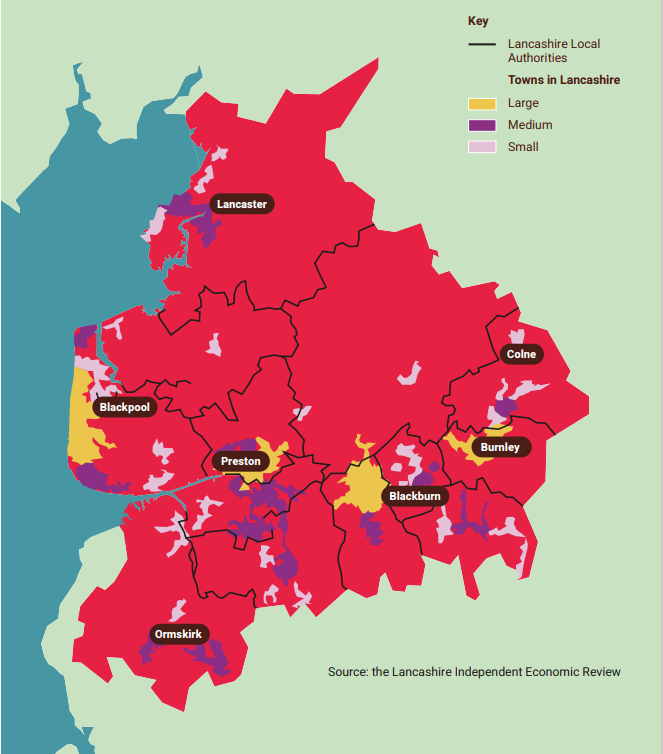
Size and location of towns in Lancashire
Case Study: Preston - A Strategic Gateway and Knowledge Hub for Lancashire
Preston is a key gateway city in the North, connecting nearly 400,000 residents, 40,000 students, and 20,000+ businesses. With a significant regional impact, it plays a vital role in driving innovation, services, and inclusive growth across Lancashire. A report exploring the role of the city has been commissioned, with stakeholder input to inform the Growth Plan.
Strategic opportunities
- Digital and creative industries - This fast-growing sector has a strong foundation and is poised for significant expansion by 2030. It supports high-tech innovation in defence, AI, and energy, reinforcing Preston’s role in future-facing industries
- Professional services expansion - A well-established sector with a strong economic contribution. Future growth will be substantial, requiring new office space and closer collaboration between the University of Central Lancashire and industry
- Entrepreneurship and productivity - Despite notable business growth, productivity challenges remain. Strengthening start-ups and innovation has the potential to deliver a transformative boost to the local economy by 2030
- Business events and tourism - Plans for a new convention centre will attract regional and global events, reinforcing Preston’s position as a knowledge and service hub where people connect and collaborate
Transformational projects strengthening our foundations for growth
The following four transformational projects will underpin economic growth, improve connectivity, and enhance quality of place.
- Preston Station Quarter – A major regeneration initiative focused on creating a vibrant, mixed- use district around Preston Railway Station, enhancing connectivity and economic activity. The scheme will also unlock new development sites and improve the public realm to create a more welcoming and accessible city gateway
- Burnley Town Centre and Canalside Masterplan – A comprehensive plan to revitalise Burnley’s town centre and canalside, supporting retail, leisure, housing, and employment growth. It will enhance the town’s appeal to investors and visitors while celebrating its heritage and improving links between key destinations
- Strategic Rail Programme – A coordinated programme of rail infrastructure improvements to enhance east-west and north-south connectivity across Lancashire and beyond. The programme will support inclusive growth by improving access to jobs, education, and services for communities across the region
- Talbot Gateway Skills and Education Campus (Multiversity) – A flagship development in Blackpool integrating education, business, and civic uses to support skills, innovation, and regeneration. It will help attract and retain talent in the region, aligning education provision with future workforce needs and industry demand
Source: Metro Dynamics. Preston Economic Statement for Preston Partnership. Presented at the #InTheCity: Growing Preston's Economy event, 26 June 2025xliv.