Sustainable digital and artificial intelligence
Lancashire is poised to lead the development of a responsible, inclusive, and sustainable digital economy. Leveraging its access to green energy and its strategic position within the emerging North West Cyber Corridor, the county is well- placed to drive productivity, create high-value employment, and deliver transformative growth through artificial intelligence (AI), big data, and cyber technologies.
The digitisation of the economy and the rise of AI are reshaping every sector. While these technologies offer significant opportunities, they also present challenges, including high energy and water demands, workforce displacement, and increased cyber vulnerability. Lancashire’s unique combination of digital connectivity, access to low-carbon power, and growing cyber infrastructure positions it to address these challenges and lead the UK’s digital transition.
Sectoral strengths and specialisms
Major industries across the county are already adopting AI, big data analytics, cryptography, and human-machine interaction to enhance productivity and develop innovative products and services. A key opportunity lies in scaling up the use of robotics and cobotics, enabled by AI, to increase industrial productivity, strengthen supply chain resilience, and address the challenges of an ageing population, workforce decline, and persistent skills gaps.
Lancashire’s digital and AI ecosystem is underpinned by:
- access to sustainable, low-cost energy to power data centres and digital infrastructure
- a growing cyber security cluster as part of the North West Cyber Corridor
- strong university-industry collaboration driving innovation and commercialisation
- a commitment to inclusive growth, ensuring digital transformation benefits all communities
Innovation and research
Lancashire’s universities are at the forefront of digital innovation, providing research excellence, business support, and skills development:
- Lancashire Universities Innovation Programme (LUIP) connects businesses with R&D expertise, helping SMEs secure Innovate UK funding and scale through Knowledge Transfer Partnerships
- Edge Hill University (EHU) hosts the SME Productivity and Innovation Centre, recognised by the ScaleUp Institute. Its Innovation Sprint Programme has delivered a £13.1 million return on government investment. EHU’s research focuses on technology adoption to boost productivity, with new initiatives supporting the professional business services sector and a recently launched Behavioural Insights service
- University of Lancashire’s Cyber Solutions Centre acts as a digital hub, applying cyber technologies across sectors such as health, policing, and public safety
- Lancaster University has received over £12 million from Research England’s Expanding Excellence in England Fund to enhance its capabilities in mathematics, statistics, and AI. This research supports applications in epidemic modelling, environmental science, aerospace, data science, and cyber security
- AMRC North West plays a pivotal role in industrial digital transformation, offering cutting-edge capabilities in cyber, AI, 5G connectivity, haptics, and knowledge capture to support manufacturing innovation at scale
- Further Education Colleges and the Institute of Technology have invested in cyber attack and defence laboratories, helping to create progression pathways into digital careers
The LCCA will leverage its extensive networks across public (including emergency services), private, and academics sectors to identifyand gather real-world use cases of artificial intelligence (AI) within the region. By mapping these applications, the LCCA will build a clearer picture of how AI is currently driving innovation and productivity across Lancashire's key industries.
In collaboration with the county's knowledge base, including universities, research centres, and innovation hubs, the LCCA will support the development of tailored AI solutions that address local challenges, enhance service delivery, and unlock new economic opportunities.
Key locations and infrastructure
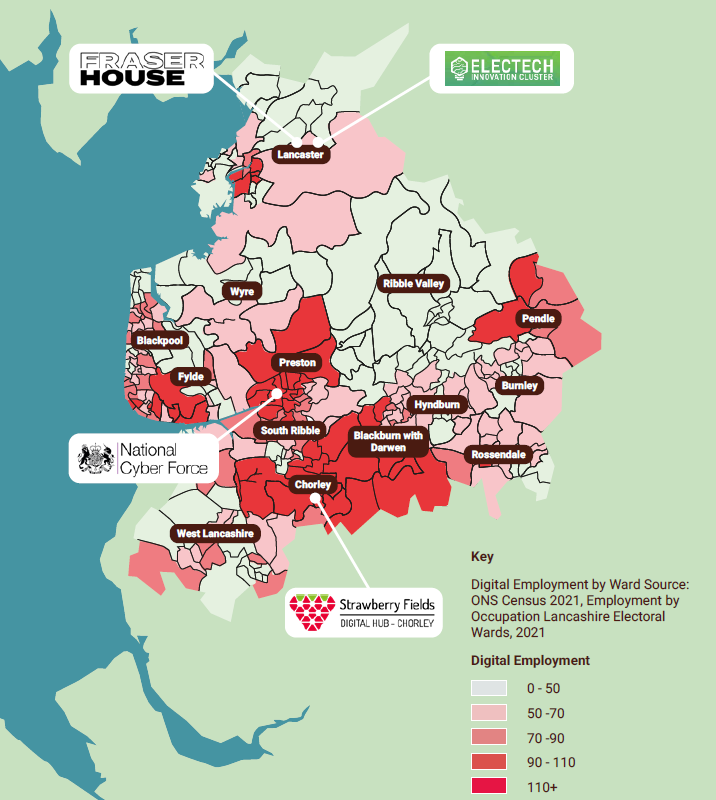
Key assets include Fraser House, Electech Cluster, National Cyber Force and Strawberry Fields.
Case Study: Fraser House
Located in Lancaster's White Cross Business Park, this co-working hub for tech and digital businesses was transformed with a £1.5 million investment by Lancashire County Council. It has helped members raise £37 million in venture capital and is a cornerstone of Lancashire's tech ecosystem.
Transformational projects
Blackburn Cyber Skills and Education Campus and Innovation Quarter
Part of a £250 million investment in Blackburn Town Centre, this development includes a high-quality office and teaching facility and a new cyber business centre. Positioned near the Samlesbury Enterprise Zone, it stengthens Blackburn's role in the North West Cyber Corridor, connecting with major business clusters and health innovation hubs.
Blackpool Airport Enterprise Zone and Silicon Sands Chorley
This zone drives economic regeneration and innovation on the Fylde Coast, supporting aviation, energy, digital, and advanced West Lancashire manufacturing sectors. Silicon Sands is pioneering the concept of net zero, sustainable data centres (powered by major offshore wind farms and solar power), leveraging immersion cooling technology and waste heat recovery with the potential to provide 1GW of data centre capacity with access to 3.4GW of green power, creating £14.3bn of GVA, 14,000 jobs and reducing fuel poverty, creating a coastal innovation district focused on digital industries and clean growth, enhancing business space, skills programmes, and R&D activity with the potential to emerge as a leading AI Growth Zone.
Digital employment distribution