
Clean growth and a nuclear renaissance
Lancashire is well positioned to lead the UK’s clean growth agenda through its strengths in clean energy production, nuclear innovation, and advanced low-carbon technologies. The county’s capabilities span the full nuclear lifecycle and are supported by strategic assets, a skilled workforce, and world-class research institutions.
The presence of Springfields Nuclear Fuels (Westinghouse Electric UK), the National Nuclear Laboratory near Preston, and Heysham Power Stations (EDF) underpins Lancashire’s role in supporting the UK’s refreshed nuclear fleet. The potential for private investment in Small Modular Reactors (SMRs), alongside energy-intensive industries such as chemicals and data centres, further strengthens Lancashire’s position as a hub for 24/7 low-carbon power generation.
Beyond nuclear, Lancashire benefits from proximity to offshore wind assets in the Irish Sea. These assets contribute to energy security and offer cost-effective power to support the competitiveness of other key sectors.
Lancashire’s advanced engineering and manufacturing (AEM) base is also well-placed to diversify into low-carbon goods and services, supporting the broader green economy.
Sectoral strengths and specialisms
Lancashire’s nuclear capabilities are nationally significant. According to the Nuclear Industry Association’s 2023 Oxford Economics studyxv:
- the nuclear sector has a GVA multiplier of 2.6, generating £1.60 in additional value for every £1 added
- GVA per worker is £95,300 (£102,300 FTE), nearly double the UK median
- the sector contributes £16.1 billion in GVA, supports 211,500 jobs, and generates £7.1 billion in tax revenue
- the north west accounts for £3.9 billion in GVA and 50,000 jobs
- nearly half of civil nuclear employment is in areas identified as high priority for investment, helping to reduce regional disparities
- operational power stations typically employ around 550 full-time staff with wage bills of £50–60 million
Lancashire’s nuclear expertise also extends to health and nuclear medicine, with applications ranging from diagnostics and imaging to advanced cancer therapies.
Innovation and research
Lancashire is home to clusters of innovation in:
- micro-hydro and carbon capture utilisation and storage (CCUS)
- flexible solar and compressed air energy storage
- thermal and solid-state sodium battery technologies
- electric vehicle (EV) battery manufacturing with global supply chain links
Nuclear employment distribution
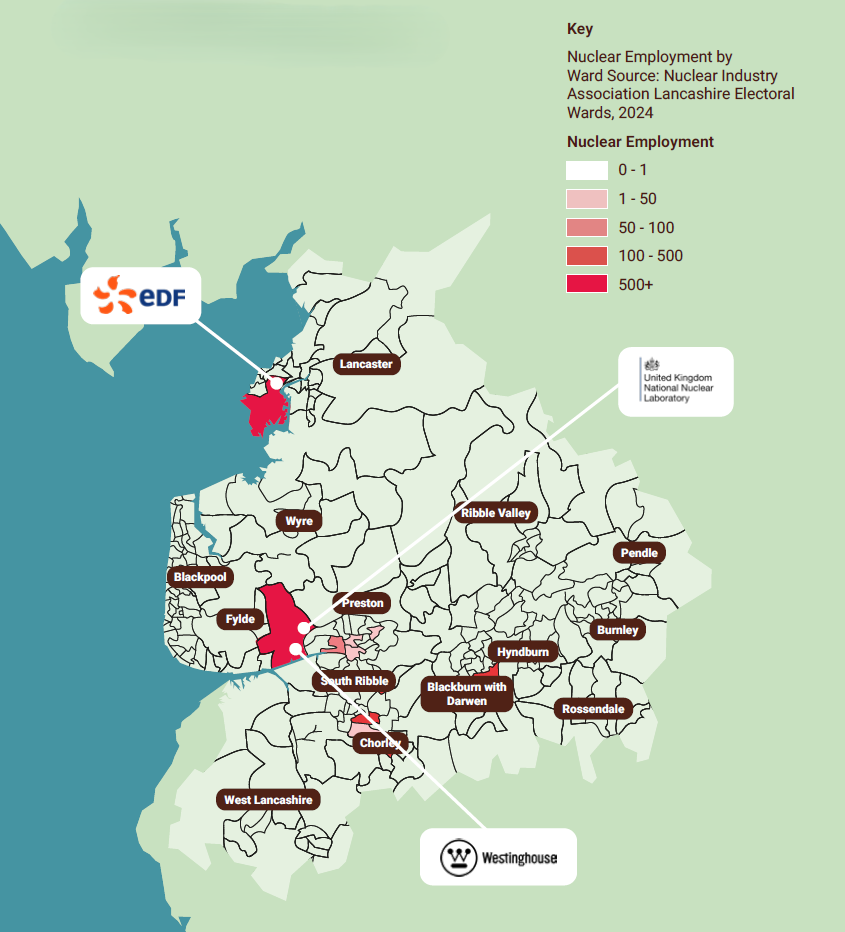
The region is also exploring the role of hydrogen in storing renewable energy for industrial use, supported by ideal geological conditions for underground storage on the Lancashire Plain.
Strategic opportunities and future growth
Lancashire is well-placed to support the development of Advanced Modular Reactors (AMRs), which operate at higher temperatures and can decarbonise broader energy systems. These reactors require High Assay Low Enriched Uranium (HALEU), currently only commercially available from Russia. With Capenhurst already engaged in enrichment processes, the Westinghouse facility at Springfields presents a strategic opportunity to re-establish UK-based HALEU production.
East Lancashire Chamber of Commerce has supported businesses innovating new low carbon products and technologies, through the sector support group RedCAT, highlighting opportunities for diversification and green job creation. The major planned offshore wind farms in the Irish Sea provide a huge opportunity which is being exploited by the Silicon Sands AI Growth Zone at Blackpool Airport Enterprise Zone, and the proposed Gateway for Clean Energy Project, centred on Fleetwood. The Hillhouse Enterprise Zone complements these efforts by seeking to align local regeneration with this opportunity to secure long-term socio-economic benefits from clean energy infrastructure and strengthen Lancashire’s role in the UK’s net zero transition.
Key locations and infrastructure
Key sites include EDF (Heysham), the National Nuclear Laboratory (Preston), and Springfields (Westinghouse UK).
Case study: CAGE Technologies
CAGE Technologies develops sustainable power solutions with their Clean Air Gas Engine (CAGE) technology, which replaces diesel engines
with low-emission alternatives like biogas and hydrogen. Their systems integrate with renewable energy sources such as solar and wind to provide clean, net-zero power. Supported through the low carbon sector network RedCAT, CAGE has received R&D funding from Innovate UK, the MOD Centre for Defence Enterprise (CDE), and BEIS to advance their clean energy innovations.
Transformational projects
- Heysham Nuclear Power Stations: Operated by EDF, these coastal stations are vital to the UK’s energy mix and future nuclear investments, including new reactor technologies, grid stability, and clean hydrogen production
- Springfields Site (Westinghouse UK): Located near Preston, this site is crucial for nuclear fuel manufacturing and supports the development of HALEU for next-generation reactors. It is central to the UK’s nuclear supply chain and export strategy