A thriving Lancashire: A national growth priority
Lancashire plays a vital role in the UK’s economic landscape. With a population of 1.57 millionvi and a Gross Value Added (GVA) of £40 billionvii, it stands as one of the largest and most dynamic economies in the north. Home to over 55,000 businesses and supporting more than 740,000 jobsviii, Lancashire’s economy is powered by strengths in advanced engineering, manufacturing, nuclear energy, cybersecurity, artificial intelligence, and sustainable industries.
The Lancashire Growth Plan sets out a bold vision for the county’s economic future at a pivotal moment. Local leaders, businesses, and investors are working together to position Lancashire as a global hub for innovation, inward investment, and economic resilience. Key to this ambition is the Lancashire Innovation Planix which ensures that investment is focused on high-impact, technology-driven sectors.
The creation of the Lancashire Combined County Authority (LCCA) marks a new chapter in devolved leadership. The LCCA will:
- champion Lancashire’s interests nationally and internationally
- deliver regional priorities through targeted investment in innovation, infrastructure, and workforce development
- strengthen inward investment strategies, making Lancashire a prime destination for global capital, venture funding, and industrial R&D
- ensure that economic growth benefits the communities that need it most
The Growth Plan focuses on a subset of Lancashire’s economy that aligns with the UK Government’s Industrial Strategy and offers significant potential to contribute to national growth. Lancashire’s unique blend of sectoral strengths forms a distinctive economic model. This includes a dual approach: supporting established industries while nurturing high- growth, high-tech enterprises, including university spin-outs and spin-ins.
While the Plan prioritises high-growth sectors, it also recognises the importance of foundational and structurally significant industries such as public services, civil society, and health and social care. It supports investment in culture, health, transport, skills, and housing as essential enablers of economic success. The evolving Get Lancashire Working programme aims to raise employment levels and ensure that local people benefit directly from economic growth.
The pipeline of projects identified in the plan has the potential to attract over £20 billion in additional investment over the next decade, transforming Lancashire’s economy and making a substantial contribution to the UK’s national growth ambitions.
National context
The Growth Plan is fully aligned with the UK’s national growth agenda. It directly supports the government’s Industrial Strategy, the Devolution White Paper, and the Get Britain Working Green Paper.
With economic growth as a national priority, this Plan places Lancashire at the heart of the UK’s future prosperity. The 2025 Spending Review reinforces this alignment, with significant funding commitments in defence, social housing, transport, and the energy transition, all of which support Lancashire’s strategic priorities.
Government's growth mission: rebuild Britain
| National priorities | Growth Plan sections |
|---|---|
| Investment, infrastruture and planning. Higher public and private investment, improved infrastrucure like transport and planning reform. | Infrastructure and place transformation (section 5) |
| Place. Regional growth through investment, devolution and reform, and support for house building. | Infrastructure and place transformation (section 5) |
| People. More people in good jobs, improved employment prospects, skills and productivity. | Skills for growth and inclusion (section 5) |
| Industrial strategy and trade. An industrial strategy and trade strategy to bolster growth-driving sectors and free open trade. | Business growth and enterprise (section 5) |
| Innovation. Support for scientific breakthroughs, R&D, and the diffusion of technologies, inclusing AI. | Knowledge and innovation assets (section 6) |
| Net zero. Net Zero delivered in a way that supports growth and captures economic opportunities. | An economic driving clean growth and a nuclear renaissance (section 2) |
| Economic and fiscal stability. Macroeconomic and financial stability, fiscal sustainability and policy certainty. |
Based on: An overarching framework for governments growth mission, budget papers, October 2024.
LCCA strategic approach
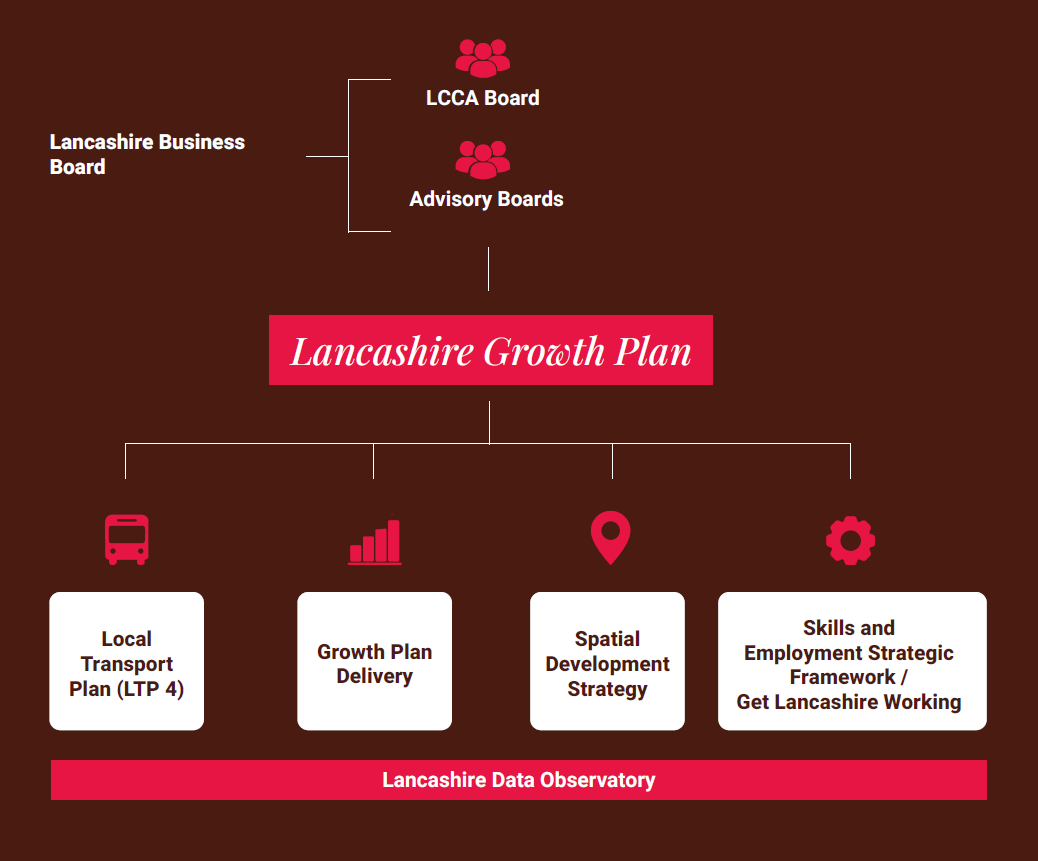
The Lancashire Growth Plan sits at the heart of the LCCA’s emerging strategic approach. It serves as the central organising document that aligns local ambition with national priorities, guiding investment, policy, and partnership activity across the county.
This model integrates a range of interconnected strategies and ensures that all parts of the system are working together to deliver inclusive, sustainable, and high-impact growth. The requirement for the Economic Growth, Transport and Skills Advisory Boards to support this work is set out in their Terms of Reference, reinforcing their role in shaping and delivering the Growth Plan’s priorities.
Integration will be further strengthened through the development of a Spatial Development Strategy (SDS), described in Section Five. The SDS will sit alongside a coordinated approach to prioritising economic growth, skills development, and transport investment, ensuring decisions are joined-up and focused on unlocking Lancashire’s full potential.
“The Growth Plan sets a bold direction for Lancashire. By aligning economic, transport, and skills priorities, we’re creating the conditions for innovation, investment, and long-term success.”
Chair of the Economic Growth Advisory Board
“The Lancashire Growth Plan sets a clear direction for our economy, and the Skills Advisory Board is committed to ensuring our workforce is ready to meet that ambition. We will continue to align our skills strategies with the Plan’s priority sectors to maximise opportunity for all.”
Chair of the Skills Advisory Board
"Transport is a key enabler of economic growth. We are working closely through the County Combined Authority to ensure that Lancashire's transport infrastructure enables the ambitions set out in the Growth Plan. The LCCA also allows us to speak with a stronger, unified voice in forums such as Transport for the North, helping to champion Lancashire's priorities more effectively at a regional and national level."
Chair of the Transport Advisory Board